
In recent years, parents have become more conscious about safe, non-invasive infant monitoring. With privacy concerns rising and wearable devices sometimes causing discomfort, radar baby monitor technology is emerging as a breakthrough solution.
Unlike traditional WiFi cameras or sensor pads, radar-based baby monitors provide contact-free breathing and motion detection, offering higher safety, greater accuracy, and improved peace of mind.
In this article, we explore the technology advantages of radar baby monitors, how they work, and why they are becoming a preferred choice for modern families.
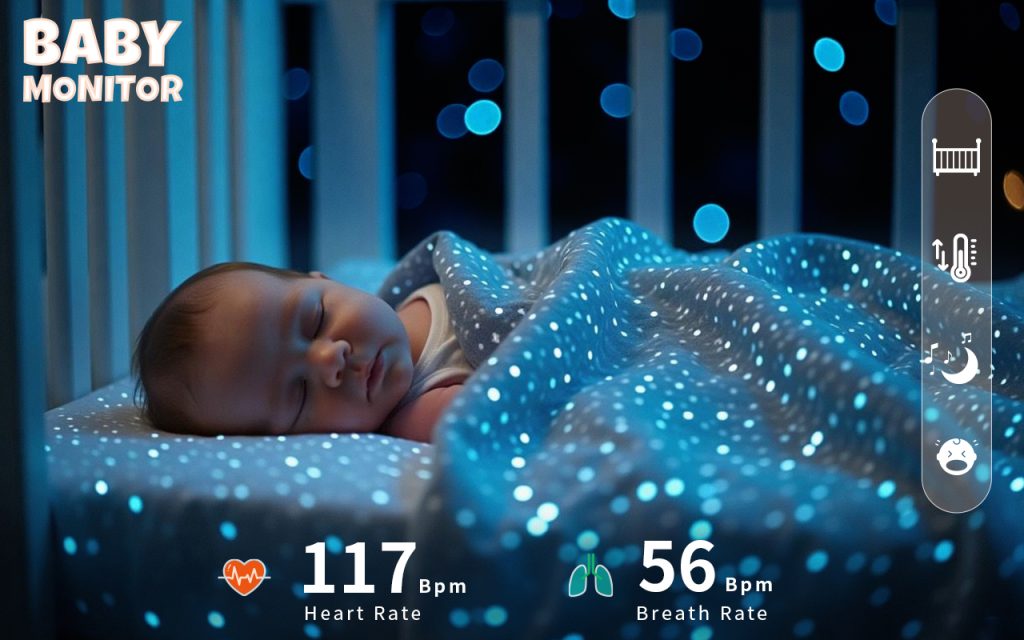
What Is a Radar Baby Monitor?
A radar baby monitor uses millimeter-wave radar technology to detect subtle movements such as:
- Baby breathing patterns
- Micro body movements
- Sleep position changes
- Presence detection
Instead of relying on cameras alone or wearable sensors attached to the baby body, radar technology tracks motion through radio waves, making it:
- Contactless
- Non-invasive
- Safe for continuous overnight monitoring
- This technology is already widely used in automotive safety systems and smart home presence detection — now adapted for infant care.
Key Technology Advantages of Radar Baby Monitors
1. Contact-Free Breathing Detection
Traditional breathing monitors often require:
- Wearable bands
- Clip-on sensors
- Mattress sensor pads
These methods can shift, loosen, or cause discomfort.
Radar baby monitors eliminate physical contact entirely. They detect micro chest movements caused by breathing without touching the baby.
2. No Skin Irritation or Safety Risk
Wearable devices may:
- Irritate sensitive newborn skin
- Create overheating risk
- Pose entanglement concerns
Radar technology removes these risks completely because nothing is attached to the baby.
For safety-focused parents searching for:
- “safe baby monitor without radiation”
- “non wearable baby breathing monitor”
Radar models are becoming increasingly attractive.
3. High Accuracy with Millimeter-Wave Technology
Modern radar baby monitors use mmWave (millimeter-wave) sensing, capable of detecting movements as small as a few millimeters.
Advantages include:
- Real-time breathing rate tracking
- Reduced false alarms
- More stable detection compared to motion-only cameras
Unlike camera-based AI detection that depends on lighting conditions, radar works in:
- Complete darkness
- Covered environments (light blanket movement detection)
4. Enhanced Privacy Protection
Many parents are concerned about WiFi camera hacking risks.
Radar baby monitors can operate:
- Without constant video streaming
- With local data processing
- Without cloud storage
This significantly reduces privacy vulnerabilities compared to internet-connected cameras.
Trending searches: non WiFi baby monitor, secure baby monitor without hacking risk
5. Works Day and Night
Unlike optical systems, radar detection:
- Is not affected by lighting
- Does not require infrared LEDs
- Maintains consistent performance in darkness
This makes radar technology especially reliable for overnight monitoring.
6. Smart Alerts & AI Integration
Advanced radar baby monitors integrate with mobile apps to provide:
- Breathing irregularity alerts
- No-movement detection notifications
- Sleep analytics
- Historical trend tracking
Some models also combine:
- Radar + camera
- Radar + temperature sensors
- Radar + crying detection
This multi-sensor fusion improves monitoring accuracy.
Radar vs Traditional Baby Monitor: Technology Comparison
| Feature | Radar Baby Monitor | Camera Monitor | Wearable Monitor |
|---|---|---|---|
| Contact-Free |  Yes Yes | Yes |  No No |
| Breathing Detection | High accuracy |  Limited Limited | Direct but wearable |
| Works in Darkness | Yes | Infrared required | Yes |
| Skin Irritation Risk | None | None | Possible |
| Privacy Risk | Lower | Higher (WiFi) | Lower |
Why Radar Baby Monitors Are a Growing Trend
As parents increasingly search for:
- Best non WiFi baby monitor
- Contactless baby breathing monitor
- Safe baby monitor for newborn
- Baby monitor without radiation concerns
Radar technology aligns perfectly with these needs.
It combines:
✔ Safety
✔ Privacy
✔ Accuracy
✔ Comfort
✔ Smart technology
For manufacturers and retailers, radar-based models also offer strong premium positioning in the mid-to-high-end baby care market.
Is Radar Baby Monitor Safe?
Millimeter-wave radar operates at very low power levels, significantly below harmful exposure thresholds. It does not emit harmful radiation and is designed specifically for safe indoor use.
Compared to constant WiFi streaming cameras, some radar systems may even reduce overall wireless exposure.
However, parents should always choose products that:
- Comply with CE / FCC certifications
- Meet regional safety standards
- Are tested for infant environments
Final Thoughts
Radar baby monitor technology represents the next evolution in infant monitoring.
By offering:
- Contact-free breathing detection
- Improved safety
- Enhanced privacy
- Reliable night performance
It addresses many of the limitations found in traditional baby monitors.
As smart nursery technology continues to advance, radar-based monitoring is likely to become a core feature in premium baby monitor systems worldwide.