
Introduction: Why Baby Monitor Range Matters for Parents
A baby monitor gives parents the freedom to stay connected with their baby while moving around the house. Whether you are cooking in the kitchen, working in another room, or relaxing outdoors, a reliable connection ensures you never miss your baby’s sounds or movements.
One of the most common questions parents ask before purchasing a baby monitor is:
“How far can a baby monitor reach?”
The answer depends on several factors, including the type of connection technology, home layout, walls, interference, and whether the monitor uses traditional wireless transmission or WiFi.
Understanding baby monitor range helps parents choose a device that matches their lifestyle and provides stable monitoring whenever they need it.
What Is the Typical Range of a Baby Monitor?
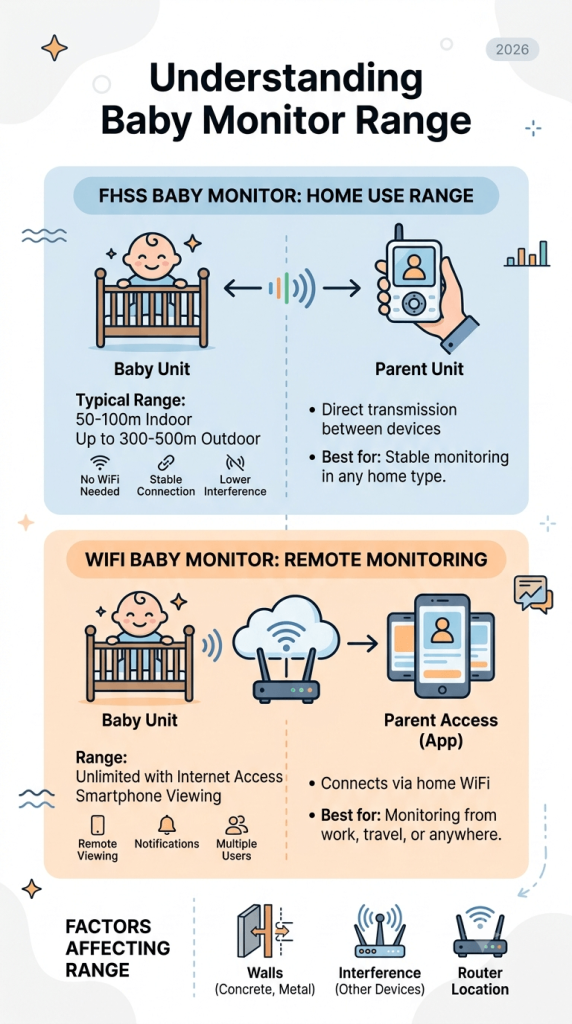
The range of a baby monitor refers to the maximum distance between the camera unit and the parent unit while maintaining a stable connection.
Generally, baby monitor ranges vary depending on the connection type:
| Baby Monitor Type | Typical Indoor Range | Outdoor/Open Area Range |
|---|---|---|
| FHSS Wireless Baby Monitor | 50-100 meters | Up to 300-500 meters |
| Digital Audio Baby Monitor | 50-150 meters | Up to 300 meters |
| WiFi Baby Monitor | Depends on WiFi coverage | Unlimited with Internet Access |
However, the actual performance can be affected by:
- Wall thickness
- Building materials
- Signal interference
- Router quality
- Distance between devices
- Battery performance
A baby monitor with a longer transmission range is especially useful for larger homes, multi-floor houses, and outdoor activities.
Baby Monitor Connection Types Explained
Different baby monitors use different wireless technologies. Choosing the right connection type is one of the most important factors when considering range and reliability.
1. FHSS Baby Monitor: Stable Connection for Home Use
FHSS (Frequency Hopping Spread Spectrum) technology is widely used in traditional wireless baby monitors.
Instead of relying on home WiFi, FHSS baby monitors transmit audio and video signals directly between the camera and parent monitor.
Advantages of FHSS Baby Monitors:
✔ Stable connection
✔ No Internet required
✔ Lower risk of network interference
✔ Fast video transmission
✔ Suitable for bedrooms and homes
Because FHSS technology works independently from WiFi networks, it is less affected by router problems or internet interruptions.
For parents who prioritize reliability and privacy, an FHSS baby monitor is still one of the best choices.
2. WiFi Baby Monitor: Remote Monitoring Anywhere
A WiFi baby monitor connects through your home network and allows parents to view their baby using a smartphone app.
Unlike traditional monitors, WiFi models are not limited by the distance between the camera and parent unit.
As long as there is an internet connection, parents can monitor their baby from:
- Another room
Office - Shopping center
- Vacation location
- Benefits of WiFi Baby Monitors:
✔ Remote access through smartphone
✔ Unlimited viewing distance
✔ Smart notifications
✔ Multiple user sharing
✔ Integration with smart home systems
However, WiFi baby monitors depend on:
- Router coverage
- Internet stability
- Network security
A weak WiFi signal may cause video delays or connection problems.
FHSS vs WiFi Baby Monitor: Which Has Better Range?
| Feature | FHSS Baby Monitor | WiFi Baby Monitor |
|---|---|---|
| Connection Method | Direct wireless transmission | Internet connection |
| Range | Limited by distance | Unlimited remotely |
| Internet Required | No | Yes |
| Stability | Very stable | Depends on WiFi |
| Privacy | Higher | Requires security protection |
| Best For | Home monitoring | Remote monitoring |
The better choice depends on your needs:
Choose FHSS Baby Monitor If You:
- Live in a house or apartment
- Want stable real-time monitoring
- Prefer no internet dependency
Need reliable nighttime monitoring
Choose WiFi Baby Monitor If You:
- Need remote viewing
- Travel frequently
- Want smartphone access
- Prefer smart features
What Factors Affect Baby Monitor Range?
Even a long-range baby monitor may experience reduced performance due to environmental conditions.
1. Walls and Building Materials
Thick walls, concrete structures, and metal materials can reduce wireless signal strength.
For example:
- Wooden walls → Less interference
- Brick walls → Moderate signal reduction
- Concrete walls → Stronger signal blocking
2. Wireless Interference
Many household devices operate on similar frequency bands, including:
- WiFi routers
- Bluetooth devices
- Microwave ovens
- Wireless speakers
Too many wireless signals may affect transmission quality.
3. Home Size and Layout
A small apartment may work well with almost any baby monitor.
However, larger homes may require:
- Longer transmission distance
- Stronger wireless technology
- WiFi connection
- Multiple camera support
How to Choose a Long Range Baby Monitor?
When selecting a baby monitor with better range, consider these features:
1. Check Transmission Distance
Look for products that clearly specify:
- Indoor range
- Outdoor range
- Transmission frequency
A quality baby monitor should provide stable performance instead of only advertising maximum distance.
2. Choose the Right Frequency Technology
Common wireless frequencies include:
- 2.4GHz
- 900MHz
- Dual-band transmission
Dual-band baby monitors can improve connection flexibility by reducing interference.
3. Consider Battery Life
A long-range baby monitor is only useful when the parent unit can operate for extended periods.
Look for:
- Long standby time
- Power-saving mode
- Low battery alerts
4. Look for Additional Smart Features
Modern long-range baby monitors often include:
- HD video
- Night vision
- Two-way audio
- Cry detection
- Temperature monitoring
- VOX voice activation
These features improve the overall parenting experience.
Can You Use a Baby Monitor Outside the House?
Many parents want to know if they can use a baby monitor in outdoor spaces such as:
- Backyard
- Garden
- Patio
- Garage
The answer depends on the product.
FHSS baby monitors with strong transmission power can often work outdoors within their specified range.
WiFi baby monitors can work anywhere with reliable internet access.
For outdoor use, parents should consider:
- Weather protection
- Signal obstacles
- Battery performance
- Camera placement
Long Range Baby Monitor: Who Needs One?
A long-range baby monitor is especially useful for:
Large Homes
Parents can monitor their baby while staying downstairs, upstairs, or in another area of the house.
Multi-Room Living
Families with separate bedrooms or playrooms benefit from stronger transmission.
Outdoor Activities
Parents can stay connected while working in the yard or relaxing outside.
Working Parents
WiFi models allow monitoring even when parents are away from home.
Future Trends: Smarter and Longer-Range Baby Monitoring
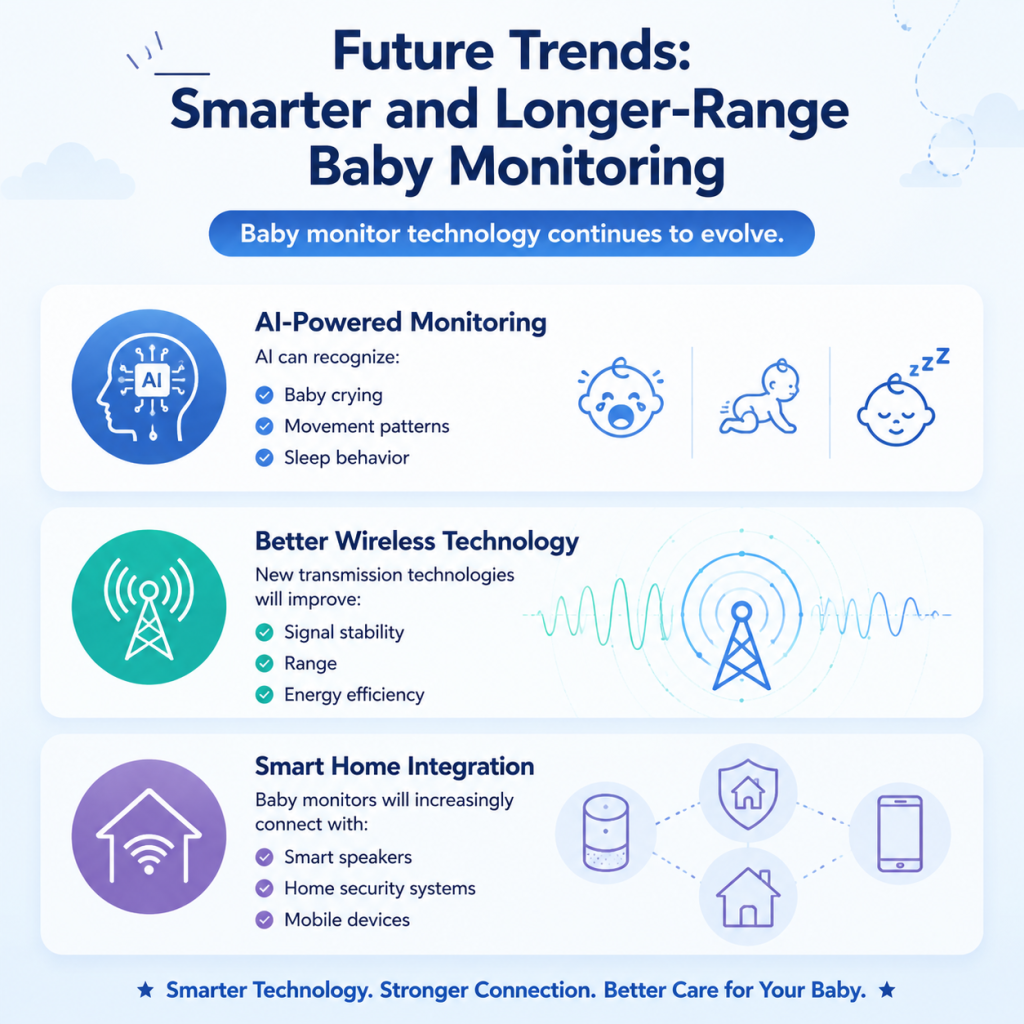
Baby monitor technology continues to evolve.
Future trends include:
AI-Powered Monitoring
AI can recognize:
- Baby crying
- Movement patterns
- Sleep behavior
Better Wireless Technology
New transmission technologies will improve:
- Signal stability
- Range
- Energy efficiency
Smart Home Integration
Baby monitors will increasingly connect with:
- Smart speakers
- Home security systems
- Mobile devices
Conclusion: Choosing the Right Baby Monitor Range for Your Family
So, how far can a baby monitor reach?
The answer depends on the type of connection:
FHSS baby monitors provide stable short-to-medium distance monitoring without internet.
WiFi baby monitors offer remote access from almost anywhere with an internet connection.
Before purchasing, parents should consider their home size, lifestyle, privacy needs, and monitoring requirements.
A reliable baby monitor is not only about maximum range — it is about maintaining a stable connection that helps parents feel confident and connected with their baby anytime.