
As parenting technology continues to evolve, AI baby monitors are becoming one of the most talked-about innovations in infant care. Unlike traditional baby monitors that simply transmit audio or video, AI-powered baby monitors can analyze your baby behavior, detect sleep patterns, recognize crying, and provide intelligent insights in real time.
But are these advanced devices truly worth the investment? And how exactly does artificial intelligence improve baby monitoring?
In this guide, we well explore how AI baby monitors work, their key advantages and limitations, and whether they are a smart choice for parents in 2026.
What Is an AI Baby Monitor?
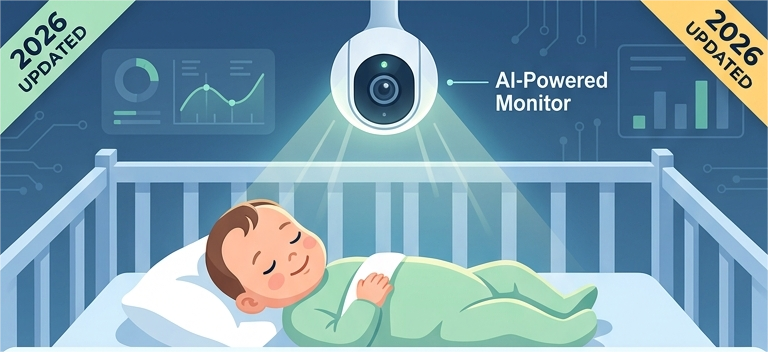
An AI baby monitor is a smart monitoring system that combines cameras, sensors, machine learning algorithms, and mobile applications to provide advanced monitoring capabilities beyond standard audio and video feeds.
Traditional monitors allow parents to see and hear their baby.
AI baby monitors go further by:
- Detecting crying automatically
- Monitoring sleep patterns
- Tracking movement activity
- Sending intelligent alerts
- Generating sleep reports
- Identifying unusual behavior
Instead of continuously watching a monitor screen, parents receive meaningful information and actionable insights.
How Do AI Baby Monitors Work?
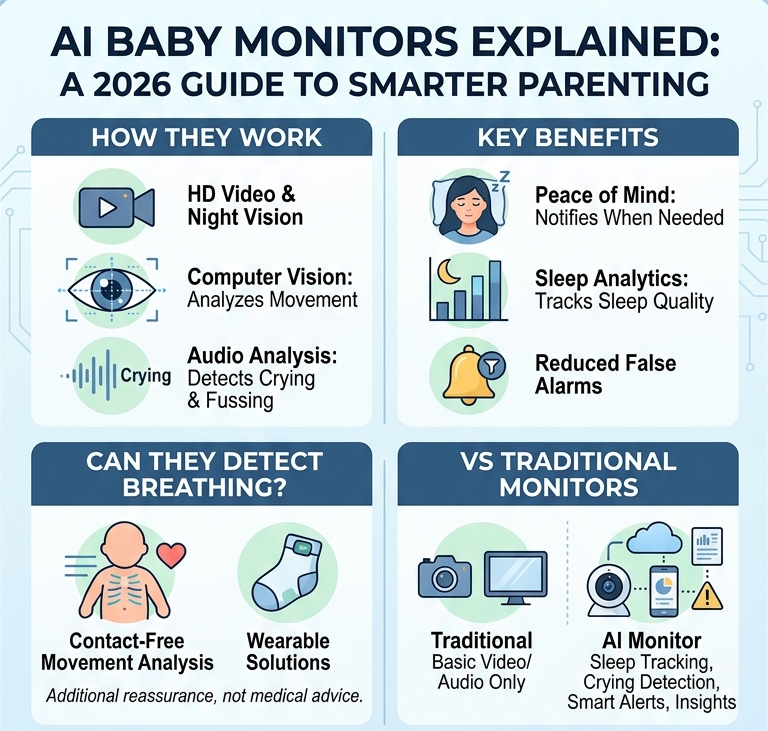
AI baby monitors rely on a combination of hardware and software technologies.
High-Definition Cameras
The monitor continuously captures video footage using:
- HD or 2K cameras
- Infrared night vision
- Wide-angle lenses
These cameras provide the visual data needed for AI analysis.
Computer Vision Technology
Computer vision allows the monitor to “see” and interpret movement patterns.
The system can recognize:
- Sleeping positions
- Body movements
- Wake-up events
- Nursery activity
Advanced models can even distinguish between normal movement and behaviors that may require parental attention.
Cry Detection and Audio Analysis
AI algorithms analyze sound patterns to identify:
- Crying
- Fussing
- Coughing
- Background noise
Some systems can differentiate between mild fussiness and genuine distress, helping reduce unnecessary notifications.
Sleep Analytics
One of the most popular AI features is sleep tracking.
The monitor can record:
- Sleep duration
- Wake frequency
- Sleep cycles
- Sleep quality trends
Parents receive daily or weekly reports that help establish healthy sleep routines.
Intelligent Notifications
Rather than sending alerts for every movement, AI systems prioritize important events.
Examples include:
- Extended crying
- Unusual inactivity
- Frequent wake-ups
- Sleep disruptions
This helps reduce alert fatigue while keeping parents informed.
Key Benefits of AI Baby Monitors
Enhanced Peace of Mind
One of the biggest reasons parents choose AI baby monitors is reassurance.
Instead of constantly checking on their baby, parents can rely on intelligent monitoring to notify them when attention is needed.
Better Sleep Insights
Understanding a baby sleep habits can be challenging.
AI-generated sleep reports help parents:
- Identify sleep patterns
- Track progress
- Improve bedtime routines
- Understand developmental changes
Reduced False Alarms
Traditional motion sensors often trigger unnecessary notifications.
AI algorithms are designed to filter out normal activity and focus on meaningful events.
Remote Monitoring
Most AI baby monitors connect to smartphone apps, allowing parents to check on their child from anywhere.
Features often include:
- Live video streaming
- Event playback
- Real-time notifications
- Multiple user access
Long-Term Data Tracking
AI systems can store historical data and generate trends over time.
This information helps parents understand how sleep and activity evolve as their baby grows.
Can AI Baby Monitors Detect Breathing?
This is one of the most common questions among parents.
The answer depends on the specific technology used.
Contact-Free Breathing Monitoring
Some advanced AI baby monitors use:
- Computer vision
- Radar sensors
- Motion analysis
These technologies can detect subtle chest movements associated with breathing.
Wearable Monitoring Solutions
Other systems use wearable devices such as:
- Smart socks
- Sensor bands
- Breathing clips
These devices collect physiological data directly from the baby.
Important Consideration
Breathing-monitoring features are designed to provide additional reassurance and should not be considered medical devices unless specifically certified for medical use.
Parents should always follow safe sleep guidelines recommended by healthcare professionals.
Potential Drawbacks of AI Baby Monitors
While AI technology offers many advantages, there are also some limitations to consider.
Higher Cost
AI baby monitors are generally more expensive than standard video monitors.
Premium models often include:
- AI analytics
- Cloud services
- Breathing detection
- Advanced app functionality
Internet Dependency
Most AI-powered systems require WiFi connectivity.
Poor internet connections may affect:
- Live streaming
- Notifications
- Cloud storage
Privacy Concerns
As with any connected device, security is important.
Parents should choose monitors that offer:
- Encrypted data transmission
- Secure cloud storage
- Two-factor authentication
- Regular firmware updates
Learning Curve
Advanced features may require more setup and app configuration compared to traditional monitors.
AI Baby Monitor vs Traditional Baby Monitor
| Feature | Traditional Monitor | AI Baby Monitor |
|---|---|---|
| Live Video | Yes | Yes |
| Audio Monitoring | Yes | Yes |
| Cry Detection | Limited | Advanced |
| Sleep Tracking | No | Yes |
| Behavior Analysis | No | Yes |
| Intelligent Alerts | No | Yes |
| Mobile App Integration | Limited | Extensive |
| Historical Reports | No | Yes |
For parents who simply want video monitoring, a traditional monitor may be sufficient.
For those seeking deeper insights into sleep and behavior, AI technology offers significant additional value.
Who Should Buy an AI Baby Monitor?
AI baby monitors may be particularly useful for:
First-Time Parents
New parents often appreciate the extra guidance and reassurance provided by AI insights.
Technology-Oriented Families
Families already using smart home devices may enjoy the convenience of integrated monitoring systems.
Parents Focused on Sleep Optimization
Sleep tracking features provide valuable information for establishing healthy sleep routines.
Parents Seeking Remote Access
Frequent travelers or working parents can stay connected through mobile monitoring applications.
Are AI Baby Monitors Worth It in 2026?
For many families, the answer is yes.
AI baby monitors are no longer just cameras with smartphone apps. They have evolved into intelligent parenting assistants capable of monitoring sleep, analyzing behavior, detecting crying, and providing actionable insights.
If your priorities include:
- Advanced sleep tracking
- Smart notifications
- Remote access
- Breathing monitoring
- Long-term data analysis
Then an AI baby monitor can be a worthwhile investment.
However, parents who only need basic video and audio monitoring may find that a traditional baby monitor meets their needs at a lower cost.
Ultimately, the best choice depends on your family lifestyle, budget, and desired level of monitoring.
Final Thoughts
AI baby monitors are transforming the way parents care for and monitor their children. By combining artificial intelligence, computer vision, and advanced sensor technology, these devices provide far more than simple video feeds.
As AI capabilities continue to improve in 2026 and beyond, baby monitors are becoming smarter, more accurate, and more helpful for modern families.
For parents seeking greater convenience, deeper sleep insights, and enhanced peace of mind, AI baby monitors represent one of the most exciting developments in smart parenting technology.