
If you’re planning to buy a baby monitor with your Flexible Spending Account (FSA), you may be wondering: Are baby monitors FSA eligible?
The short answer is: it depends on the type of baby monitor and how it is used.
A standard baby monitor designed primarily for general nursery supervision is generally different from a medical monitoring device used to monitor a specific medical condition. FSA eligibility can depend on whether the product qualifies as a medical expense and whether your FSA administrator requires additional documentation.
For example, FSAFEDS lists medical monitoring and testing devices as eligible with a detailed receipt. Some products that have both personal and medical uses may require additional documentation, such as a Letter of Medical Necessity from a healthcare provider.
This guide explains what parents should know about FSA-eligible baby monitors, medical monitoring devices, documentation requirements, and how to check whether a particular baby monitor may qualify.
Are Baby Monitors FSA Eligible?
Most traditional baby monitors are not automatically FSA eligible simply because they are used for babies.
A basic video baby monitor is generally designed for everyday childcare and nursery supervision. It may include features such as:
- HD video
- Night vision
- Two-way audio
- Temperature monitoring
- Pan and tilt
- Motion alerts
These features can be useful for parents, but they do not necessarily make a product a qualified medical expense.
The important distinction is between a product used primarily for general childcare and a device used for medical monitoring or treatment of a specific condition.
FSAFEDS specifically lists medical monitoring and testing devices among eligible expenses when supported by a detailed receipt.
What Makes a Baby Monitor Potentially FSA Eligible?
The key question is not simply whether a product is called a “baby monitor.”
Instead, consider its primary purpose and medical function.
A baby monitor may have a stronger basis for FSA reimbursement when it functions as a medical monitoring device and is used because of a diagnosed or suspected medical condition.
For example, a specialized monitor may be designed to monitor:
- Breathing patterns
- Heart rate
- Blood oxygen levels
- Other physiological measurements
- Specific medically relevant events
However, having one of these features does not automatically guarantee FSA eligibility.
Your FSA administrator may require documentation showing that the device is medically necessary.
Standard Baby Monitor vs Medical Baby Monitor
Understanding the difference between these two categories can help explain why FSA eligibility varies.
| Feature | Standard Baby Monitor | Medical Monitoring Device |
|---|---|---|
| Primary purpose | Nursery supervision | Medical monitoring |
| Video monitoring | Common | May be included |
| Night vision | Common | May be included |
| Two-way audio | Common | May be included |
| Cry detection | Sometimes | May be included |
| Temperature monitoring | Sometimes | May be included |
| Breathing monitoring | Usually not medical-grade | May be available |
| Heart-rate monitoring | Usually not | May be available |
| Oxygen monitoring | Usually not | May be available |
| Medical necessity | Usually not | May apply |
| FSA eligibility | Not automatically eligible | May qualify depending on circumstances |
The distinction is important because the IRS framework generally focuses on expenses related to medical care rather than ordinary personal or childcare expenses. IRS Publication 502, for example, distinguishes medical expenses from ordinary childcare costs.
What About Baby Breathing Monitors?
One area that parents frequently ask about is baby breathing monitors.
A breathing monitor may be designed to detect or track breathing-related events rather than simply provide video of a sleeping baby.
Some FSA expense lists specifically recognize baby breathing monitors in certain circumstances. For example, a published FSA eligibility guide from Multnomah County states that a baby breathing monitor may be eligible when recommended by a physician for a specific medical condition and supported by a Letter of Medical Necessity.
This illustrates an important point:
The medical purpose and documentation can matter more than the product general category.
Parents should therefore check with their FSA administrator before assuming that a particular breathing monitor will qualify.
Can an AI Baby Monitor Be FSA Eligible?
The growing popularity of AI baby monitors makes this question increasingly relevant.
Modern smart baby monitors may include features such as:
- AI crying detection
- Sleep analysis
- Movement detection
- Breathing monitoring
- Heart-rate monitoring
- Temperature alerts
- Activity tracking
- Smart notifications
However, advanced technology by itself does not necessarily make a product FSA eligible.
For example, an AI baby monitor that uses artificial intelligence to identify crying or movement may still primarily function as a childcare and nursery-monitoring product.
On the other hand, a device specifically designed and used for medical monitoring may fall into a different category.
Therefore, parents should look at the intended medical purpose, product documentation, and FSA administrator requirements, rather than relying only on terms such as “AI,” “smart,” or “health monitoring.”
Does a Doctor Letter Make a Baby Monitor FSA Eligible?
Not necessarily.
A Letter of Medical Necessity (LMN) can be important when a product is not automatically eligible but is being purchased to treat or monitor a specific medical condition.
FSAFEDS provides a Letter of Medical Necessity process for products or services that may require medical justification. The form asks the healthcare provider to identify the medical condition and describe the recommended treatment, including the specific product or service.
In other words:
A doctor letter can support a claim, but it does not mean every baby monitor automatically becomes FSA eligible.
The FSA administrator ultimately determines whether the claim meets the applicable requirements.
What Documentation May Be Required?
If your baby monitor is potentially eligible because it serves a medical purpose, you may need documentation.
Depending on your plan, this may include:
1. Detailed Receipt
Keep the original itemized receipt showing:
- Product name
- Purchase date
- Purchase amount
- Seller information
FSAFEDS specifically advises participants to keep receipts and supporting documentation for FSA claims.
2. Product Information
Your administrator may request information explaining what the device does.
Useful information can include:
- Product model
- Medical monitoring functions
- User manual
- Product specifications
- Intended use
3. Letter of Medical Necessity
If the device is being purchased to address a specific medical condition, your FSA administrator may require an LMN.
The documentation should generally explain:
- The medical condition
- Why the device is needed
- What the device monitors
- How it supports the recommended care
FSAFEDS states that its Letter of Medical Necessity must be completed by a medical care provider when such documentation is required.
Are Baby Monitors HSA Eligible Too?
Parents sometimes search for both “Are baby monitors FSA eligible?” and “Are baby monitors HSA eligible?”
The concepts are similar because both accounts can cover qualified medical expenses, but eligibility is determined under the applicable tax and plan rules.
The IRS explains that qualified medical expenses for tax-advantaged health accounts generally relate to medical care, and its guidance distinguishes qualifying medical expenses from ordinary personal expenses.
Therefore, you should not assume that because a product is sold as a baby monitor, it automatically qualifies for either an FSA or HSA.
Always check the requirements of your specific plan.
How to Check If Your Baby Monitor Is FSA Eligible
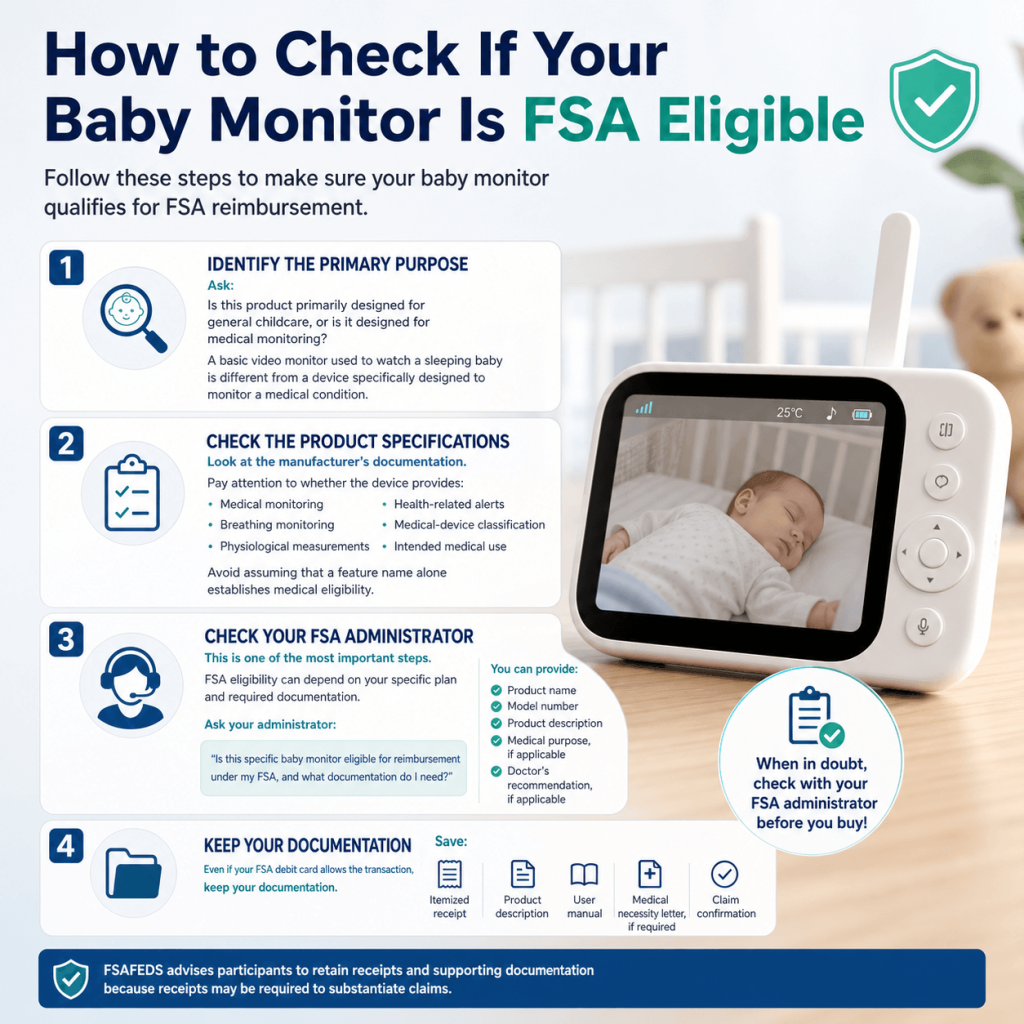
Before purchasing a baby monitor with FSA funds, follow these steps.
Step 1: Identify the Primary Purpose
Ask:
Is this product primarily designed for general childcare, or is it designed for medical monitoring?
A basic video monitor used to watch a sleeping baby is different from a device specifically designed to monitor a medical condition.
Step 2: Check the Product Specifications
Look at the manufacturer documentation.
Pay attention to whether the device provides:
- Medical monitoring
- Breathing monitoring
- Physiological measurements
- Health-related alerts
- Medical-device classification
- Intended medical use
Avoid assuming that a feature name alone establishes medical eligibility.
Step 3: Check Your FSA Administrator
This is one of the most important steps.
FSA eligibility can depend on your specific plan and required documentation.
Ask your administrator:
“Is this specific baby monitor eligible for reimbursement under my FSA, and what documentation do I need?”
You can provide:
- Product name
- Model number
- Product description
- Medical purpose, if applicable
- Doctor recommendation, if applicable
- Step 4: Keep Your Documentation
Even if your FSA debit card allows the transaction, keep your documentation.
Save:
- Itemized receipt
- Product description
- User manual
- Medical necessity letter, if required
- Claim confirmation
FSAFEDS advises participants to retain receipts and supporting documentation because receipts may be required to substantiate claims.
Common Questions About FSA and Baby Monitors
Can I buy a regular baby monitor with my FSA?
A standard baby monitor is not automatically FSA eligible simply because it is used for infant care. Eligibility depends on whether the expense qualifies as a medical expense under your plan.
Is a baby breathing monitor FSA eligible?
It may be eligible in certain medical circumstances. Some FSA guidance identifies baby breathing monitors as potentially eligible when they are recommended by a physician for a specific medical condition and supported by appropriate documentation.
Is a baby monitor with heart-rate monitoring FSA eligible?
Not automatically. Heart-rate monitoring may make a device more medically oriented, but the feature alone does not guarantee FSA reimbursement. Check your FSA administrator requirements.
Does a Letter of Medical Necessity guarantee reimbursement?
No. An LMN can provide supporting documentation when medical necessity is required, but the claim still needs to meet the applicable FSA rules.
Can I use my FSA card to buy a baby monitor?
Whether an FSA card can be used does not by itself establish that an expense is eligible. If a transaction is declined or later requires substantiation, you may need to provide documentation to your FSA administrator.
What Parents Should Know Before Buying
If you’re specifically looking for a baby monitor that may support medical monitoring needs, pay close attention to the distinction between general-purpose baby monitoring and medical monitoring.
A standard video baby monitor can be an excellent tool for everyday nursery supervision, with features such as:
- 1080P HD video
- Infrared night vision
- Two-way audio
- Pan and tilt
- Temperature monitoring
- Cry alerts
- Multiple-camera support
More advanced smart and AI baby monitors may add:
- Sleep analysis
- Breathing monitoring
- Heart-rate monitoring
- AI alerts
- Activity tracking
- Historical data
These features can provide additional information for parents, but they should not automatically be interpreted as medical diagnosis or treatment.
For any health-related monitoring, parents should follow their healthcare provider advice and verify whether a particular product is appropriate for their situation.
Final Answer: Are Baby Monitors FSA Eligible?
So, are baby monitors FSA eligible?
Not necessarily.
A standard baby monitor used for ordinary nursery supervision should not be assumed to qualify simply because it is used for a baby.
A specialized device used for medical monitoring may potentially qualify when it meets the applicable requirements and, where required, is supported by documentation such as a detailed receipt or Letter of Medical Necessity. FSAFEDS currently lists medical monitoring and testing devices as eligible with a detailed receipt, while certain medically necessary dual-purpose products require additional documentation.
Because FSA rules and plan administration can vary, the safest approach is to check with your specific FSA administrator before purchasing the product.
For parents researching baby monitors, the most important question isn’t simply whether a monitor has advanced technology. It’s whether the device intended purpose, medical function, documentation, and your FSA plan requirements all support the claim.