
Sinofly Radar 7 vs Nanit vs Owlet
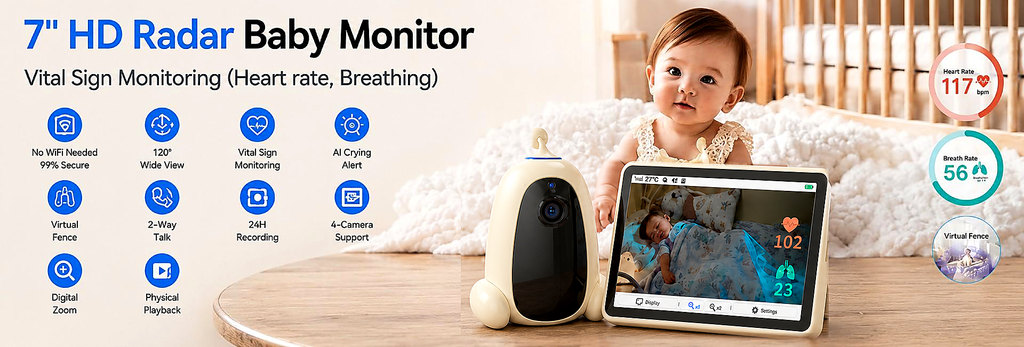
If you want medical-grade blood-oxygen data, the Owlet Dream Duo 2 is still the only FDA-cleared option here. But if you want non-contact heart-rate and breathing tracking, a big dedicated 7-inch screen, multi-child camera coverage, and local-only privacy — without a monthly subscription — the sinofly Radar 7″ Baby Monitor is the one that bundles what Nanit and Owlet split across three devices. In 2026, the category is shifting hard toward non-contact sensing and cyber-resilient local storage (over 65% of manufacturers now ship end-to-end encryption, and non-contact breathing monitors passed 35% penetration in tier-1 households). This spec-based comparison breaks down exactly where each monitor wins, where it falls short, and who should buy which.The 2026 Shift: Why Non-Contact Monitoring Is Winning
Three trends define the 2026 baby-monitor market, and they all favor a radar-based, local-first design:
-
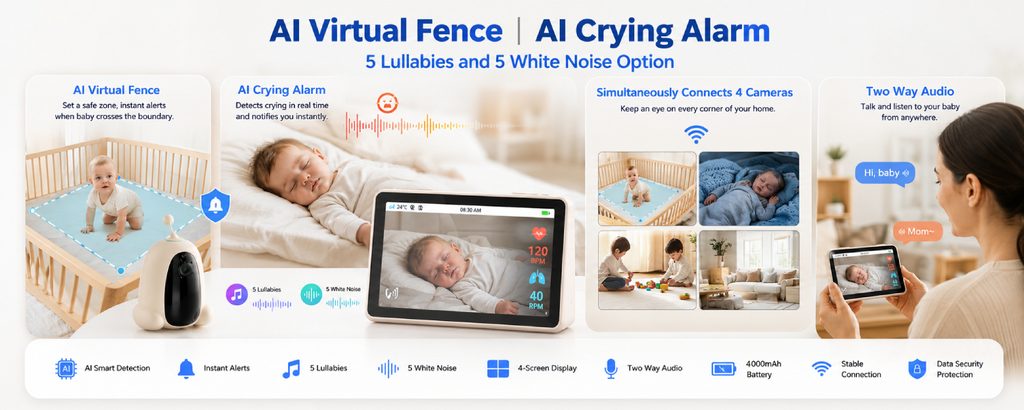
- Non-contact vital sensing hit its peak. New 2026-gen cameras detect the subtle rise and fall of a baby’s chest without wearable socks or clips (Crane Flower market research, 2026).
-
- Cyber-resilient monitoring is now table stakes. More than 65% of manufacturers implemented mandatory end-to-end encryption after 2025 privacy concerns; local storage and on-device processing are becoming standard (Crane Flower, 2026; ZVZO consumer report, 2026).
-
- AI safety alerts are selling. Monitors with covered-face and rollover alerts saw a ~15% sales spike as parents prioritize proactive safety over basic audio (Crane Flower, 2026).
The global market was valued at US1.24 billion in 2025** and is projected to reach **US1.98 billion by 2036 (CAGR 4.3%) — with North America holding ~37.6% share (Crane Flower; PMarketResearch, 2025).
Meet the Three Contenders
| sinofly Radar 7″ Monitor | Nanit Pro | Owlet Dream Duo 2 | |
| Type | Radar non-contact + 7″ screen | Overhead cam + breathing band | Wearable sock + cam |
| Price (Oct 2026) | [$123] | ~$239.99–299 |
$349.99–399.99 |
| Display | 7″ 1080p dedicated LCD | Phone app (8″ screen sold separately) | Phone app + base-station light |
| Vitals | Radar HR + breathing (no contact) | Breathing motion via contact band (0–3 mo) | FDA-cleared SpO2 + HR via foot sock (1–18 mo) |
| Internet | 2.4G WiFi-Direct, works offline | Requires WiFi (dead without it) | Requires WiFi |
| Storage | Local microSD up to 256GB | Cloud (subscription for history) | Cloud (48h free, upgrade for more) |
| Cameras | 1 receiver + 4 cameras, 4-screen | 2-cam split-screen | 1 cam (sock is wearable) |
| Two-way audio | Yes | Yes | Yes |
| Night vision | 5 m | IR (strong) | Auto-adjusting |
| Lullabies / white noise | 5 + 5 | Background audio only | No |
| Battery | 4000 mAh built-in | ~4 hrs portable mount | Sock ~16 hrs; cam plugged in |
| Subscription | None | 5–17.99/mo after year 1 |
None mandatory |
| Region | 10 languages (global) | Global | US-only |
1. Vitals: Radar Non-Contact vs Wearable Sock vs Breathing Band
This is the heart of the decision.
-
- Owlet is the only one here with FDA-cleared pulse oximetry — it reads actual blood-oxygen (SpO2) and pulse from a foot sock. For families with a NICU history or high respiratory anxiety, that medical-grade number matters (Owlet; Caring Mommy, verified May 2026). The trade-off: the sock must be charged, can slip off, and may leave red marks; it fits only 1–18 months / 6–30 lbs.
-
- Nanit tracks breathing motion via a patterned Breathing Band swaddle (contact, 0–3 months, then you buy larger sizes). It is explicitly not a medical device and does not measure oxygen.
-
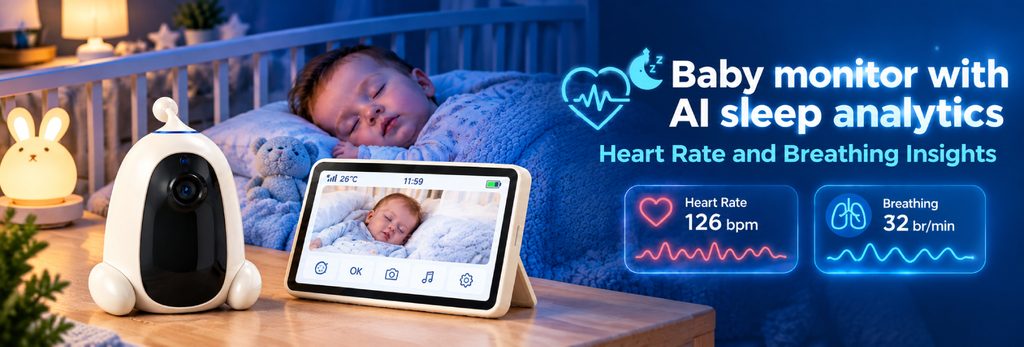
- sinofly Radar 7″ uses radar to read heart rate and breathing with zero contact — no sock, no band, no skin contact, no nightly charging. It shows real-time vitals plus historical query. Honest caveat: like most consumer non-contact systems, it tracks breathing/HR trends, not FDA-cleared SpO2. Independent testing (Pediatric Research, 2025) shows consumer wearable SpO2/HR sensors have higher false-alarm rates during movement — a reason many hospitals advise against relying on any consumer wearable for clinical decisions.
Takeaway: Want validated oxygen → Owlet. Want zero-contact, no-fuss vitals → Radar. Want sleep analytics → Nanit.
2. The Screen Problem: A Dedicated 7″ vs Phone-Only
Nanit and Owlet both push you toward a phone as the only monitor (Nanit sells an 8″ screen separately; Owlet has just a base-station light). At 3 a.m., a glowing phone in the nursery is a sleep killer, and a dead phone battery means no monitor.
The sinofly Radar 7″ ships with a large full-color 1080p LCD parent unit — no phone required. It also supports single / dual / triple / quad split-screen, so one handheld shows up to four rooms at once. For parents who’d rather not hand the nursery over to their smartphone, this is the single biggest quality-of-life difference.
3. Privacy & Internet: Local SD + 2.4G WiFi Direct Connection Without External Network
2026 buyers rank data accuracy and privacy above brand premium — over 60% weigh app UX and data security as core purchase factors (ZVZO, 2026), and private/local storage crossed 25% market share.
-
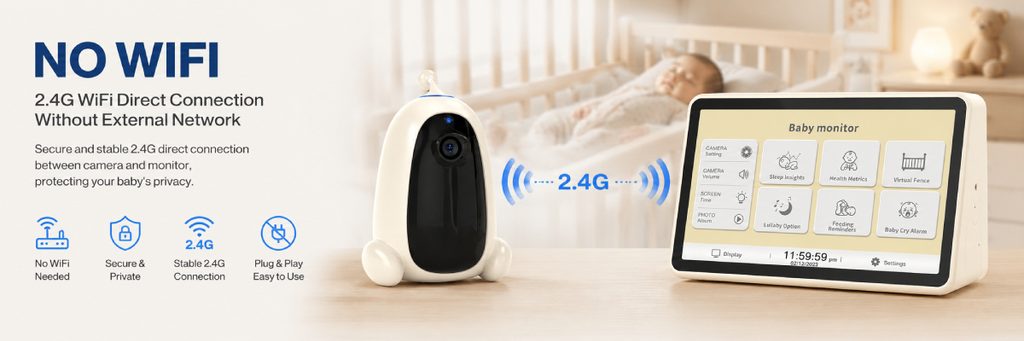
- sinofly Radar 7″ records 7×24 to a local microSD (up to 256GB), plays back on the display, and uses 2.4G WiFi-Direct with no external network — your video and vitals stay in the house. You can browse photos and replay video right on the screen.
-
- Nanit / Owlet lean on cloud streaming; full history typically needs a subscription (Nanit) or an upgrade tier (Owlet).
If “my baby’s video never leaves my home” is a requirement, the Radar is the clear pick.
4. Multi-Child Households: The 4-Camera Hub
2026’s “multi-child hub” trend (monitors managing up to four synchronized feeds on one unit) maps directly onto the Radar’s 1 receiver + 4 cameras architecture with quad-view. Nanit caps at two-cam split-screen; Owlet is fundamentally a single-camera-plus-sock system. For twins, toddlers in separate rooms, or a growing family, the Radar scales without buying a second system.

5. Price & Subscription
-
- Owlet Dream Duo 2: $
349.99–$399.99, no mandatory subscription, but US-only and sock-bound.
- Owlet Dream Duo 2: $
-
- Nanit Pro: ~$
239.99–$299 hardware, then5–17.99/month for full sleep analytics after year one.
- Nanit Pro: ~$
-
- Radar 7″: $123 — no subscription, local storage included, 10-language global firmware, customizable color/logo for resellers.
Over a two-year ownership, the Radar’s zero-subscription model is usually the cheapest total cost — a point worth leading with if price is the objection.
Who Should Choose the Radar 7″ Monitor
-
- Parents who want non-contact vitals (no sock to charge, no band to size).
-
- Families needing a real screen, not a phone, especially for night shifts.
-
- Privacy-first buyers who want local SD storage and offline operation.
-
- Multi-child homes that need 2–4 camera coverage from one unit.
-
- Global / non-US buyers (10 languages; not US-locked like Owlet).
Choose Owlet if medical-grade SpO2 is non-negotiable. Choose Nanit if deep sleep coaching analytics are your priority and you live in a solid-WiFi home.
The Honest Caveats
-
- Not a medical device. No consumer baby monitor — including Owlet’s FDA-cleared sock — is cleared by the FDA to prevent SIDS, and the AAP does not recommend home breathing monitors to reduce SIDS risk (New Mamaa; MyAwesomeBuy, 2026). Use any monitor for reassurance, never as a substitute for safe sleep (back-to-sleep, firm flat surface, room-sharing without bed-sharing).
-
- Radar tracks HR + breathing trends, not SpO2. If you need oxygen saturation, Owlet is the only option above that provides it.
-
- Verify range and radar accuracy in your room layout — wall materials and camera distance affect non-contact sensing; treat spec numbers as lab-ideal.
FAQ
1. Does the Radar 7″ baby monitor need the internet to work? No. It uses 2.4G WiFi-Direct with no external network, so local monitoring, recording, and playback work even if your home internet is down. Cloud features (if any) are optional.
2. Is the Radar monitor better than Owlet for vital signs? It depends on what “better” means. Owlet provides FDA-cleared blood-oxygen (SpO2) — the Radar does not. The Radar provides non-contact heart rate and breathing with no wearable, plus a 7″ screen and local storage. For contact-free convenience, the Radar wins; for validated oxygen data, Owlet wins.
3. Can it cover more than one room or child? Yes. One receiver pairs with up to four cameras and shows single, dual, triple, or quad split-screen views — ideal for multi-child or multi-room homes.
4. Is my baby’s video stored in the cloud? By default, video records to a local microSD card (up to 256GB) and plays back on the display. No forced cloud upload — a privacy advantage over cloud-first competitors.
5. What about the subscription fees Nanit charges? The Radar 7″ has no mandatory subscription. All core features — vitals, recording, playback, multi-camera, lullabies — are included in the hardware.