
Choosing a baby monitor today isn’t just about video quality or smart features—it’s about safety, privacy, and peace of mind.
One of the most searched questions by parents in 2026 is:
👉 “Should I choose a WiFi or non-WiFi baby monitor?”
In this guide, we break down the differences, pros and cons, and help you decide which option is best for your family.
What Is a WiFi Baby Monitor?
A WiFi baby monitor connects to your home internet and allows you to monitor your baby through a smartphone app.
Key Features:
Remote access from anywhere
App notifications and alerts
Cloud video storage
Smart integrations (Alexa / Google Home)
👉 These are often called “smart baby monitors” and are popular among tech-savvy parents.
What Is a Non-WiFi Baby Monitor?
A non-WiFi baby monitor (also called digital or RF monitor) works using a direct signal between the camera and a parent unit.
Key Features:
No internet required
Closed-loop connection
Plug-and-play setup
More stable connection
👉 Ideal for parents who prioritize privacy and simplicity.
WiFi vs Non-WiFi Baby Monitors: Key Differences
| Feature | WiFi Baby Monitor | Non-WiFi Baby Monitor |
|---|---|---|
| Connectivity | Internet-based | Direct signal (FHSS) |
| Remote Access | ||
| Security Risk | Higher | Very low |
| Setup | App required | Easy plug & play |
| Signal Stability | Depends on WiFi | Very stable |
| Travel Use | Less convenient | More convenient |
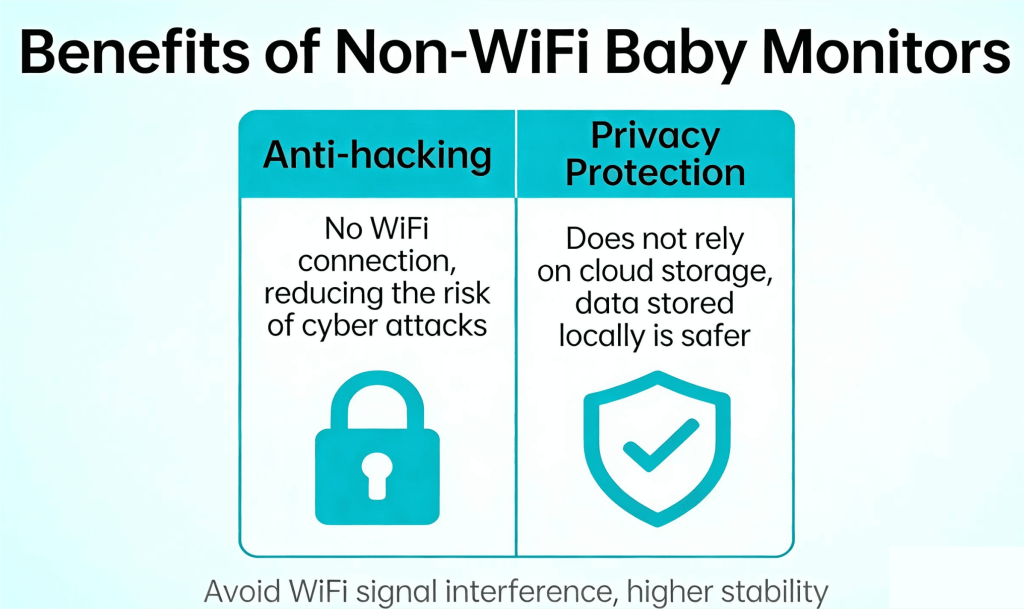
Which Baby Monitor Is Safer?
🔒 Privacy & Hacking Risks
WiFi baby monitors can be vulnerable to hacking if not properly secured.
Weak passwords
Unencrypted data
Cloud storage risks
👉 Non-WiFi monitors are much harder to hack because they don’t connect to the internet.
📡 Radiation Concerns
A growing number of parents are searching for “low radiation baby monitors”.
WiFi monitors emit continuous wireless signals
Non-WiFi monitors typically use lower, short-range transmission
👉 While both are considered safe, non-WiFi monitors are often preferred by safety-conscious families.
⚠️ Reliability in Emergencies
WiFi monitors can fail during internet outages
Non-WiFi monitors continue working regardless of network
👉 For uninterrupted monitoring, non-WiFi wins.
When Should You Choose a WiFi Baby Monitor?
Choose WiFi if you:
Travel frequently or work away from home
Want to monitor your baby remotely
Prefer smart features like AI alerts
Need cloud video recording
👉 Best for modern, connected lifestyles
When Should You Choose a Non-WiFi Baby Monitor?
Choose non-WiFi if you:
Care deeply about privacy and security
Want zero hacking risk
Prefer simple, reliable devices
Need a monitor for travel or grandparents
👉 Best for safety-focused and traditional users
How to Choose the Right Baby Monitor (Quick Checklist)
Before buying, ask yourself:
Do I need remote access?
Is privacy my top concern?
Will I use it while traveling?
Do I trust my home WiFi security?
Final Verdict
There is no one-size-fits-all answer:
✅ Choose WiFi baby monitors for convenience and smart features
✅ Choose non-WiFi baby monitors for safety, privacy, and reliability
👉 In 2026, more parents are leaning toward privacy-first solutions, making non-WiFi and hybrid monitors increasingly popular.