
Choosing a baby monitor can be confusing, especially when you need to decide between a WiFi baby monitor and a non-WiFi baby monitor.
Both types can help parents keep an eye on their baby, but they work differently and offer different advantages. WiFi models provide remote access and smart features, while non-WiFi models offer a simple, direct connection without relying on home internet.
So, which baby monitor is right for you?
In this guide, we well compare WiFi and non-WiFi baby monitors based on connection, video quality, privacy, convenience, smart features, and everyday use.
What Is a WiFi Baby Monitor?
WiFi baby monitor connects to your home WiFi network and usually works with a smartphone app.
With a WiFi-connected monitor, parents can check their baby room remotely using a smartphone or tablet. Depending on the model, you may also receive notifications when crying, movement, or other events are detected.
Common features include:
- HD or 1080P video
- Smartphone app access
- Remote monitoring
- Two-way audio
- Night vision
- Motion detection
- Cry detection
- Temperature monitoring
- Video recording
- AI-powered alerts
- Sleep tracking
WiFi baby monitors are especially useful for parents who want to monitor their baby while they are working, traveling, or away from home.
What Is a Non-WiFi Baby Monitor?
A non-WiFi baby monitor normally uses a dedicated camera and parent unit to transmit video and audio directly.
Because it does not depend on an internet connection, parents can monitor their baby using the included screen without connecting the monitor to a smartphone or cloud service.
Common features include:
- 5-inch or 7-inch HD display
- 720P or 1080P video
- Infrared night vision
- Two-way audio
- Pan and tilt
- Digital zoom
- Temperature monitoring
- Long-range transmission
- Multiple-camera support
For parents who mainly need monitoring at home, a non-WiFi baby monitor can provide a simple and convenient solution.
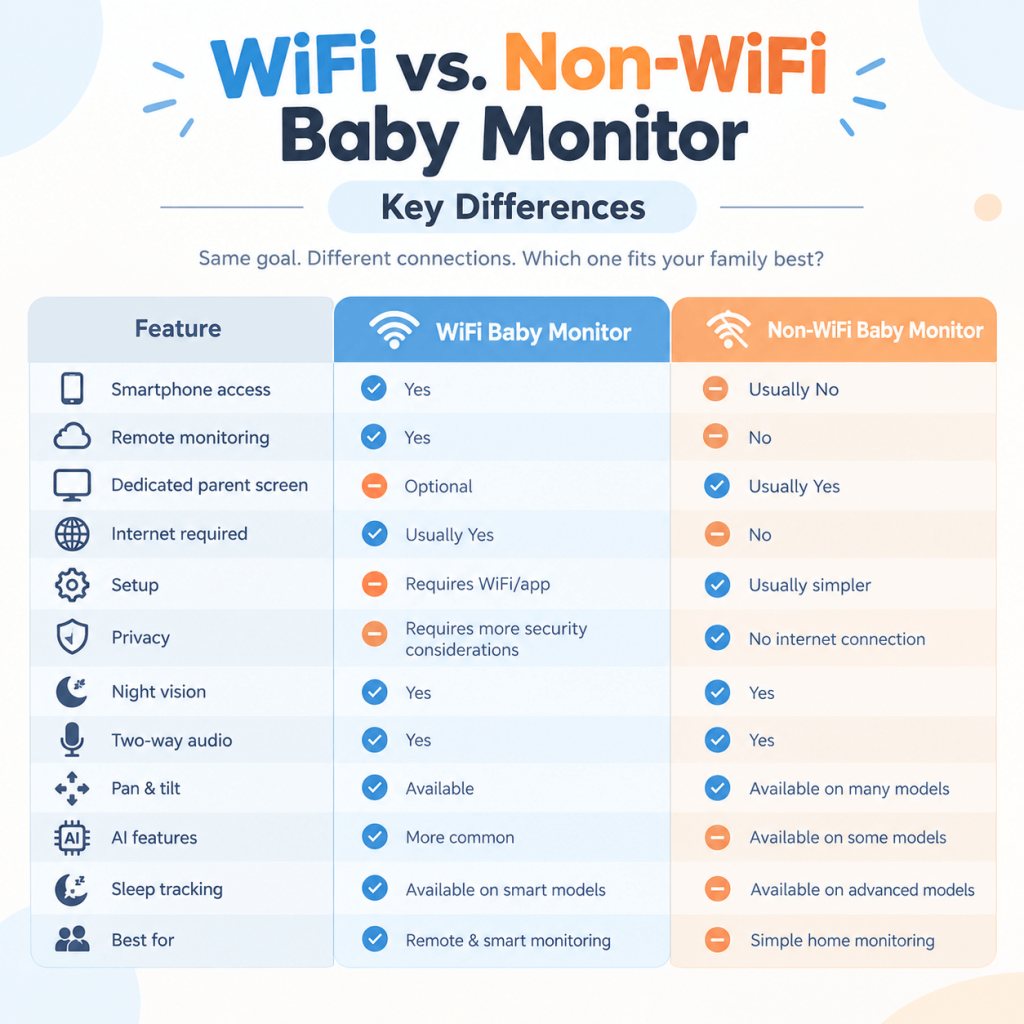
WiFi vs. Non-WiFi Baby Monitor: Key Differences
| Feature | WiFi Baby Monitor | Non-WiFi Baby Monitor |
|---|---|---|
| Smartphone access | Yes | Usually No |
| Remote monitoring | Yes | No |
| Dedicated parent screen | Optional | Usually Yes |
| Internet required | Usually Yes | No |
| Setup | Requires WiFi/app | Usually simpler |
| Privacy | Requires more security considerations | No internet connection |
| Night vision | Yes | Yes |
| Two-way audio | Yes | Yes |
| Pan & tilt | Available | Available on many models |
| AI features | More common | Available on some models |
| Sleep tracking | Available on smart models | Available on advanced models |
| Best for | Remote & smart monitoring | Simple home monitoring |
Which Is Better: WiFi or Non-WiFi?
There is no single answer.
The better choice depends on how you plan to use your baby monitor.
Choose a WiFi Baby Monitor If You:
Want to monitor your baby remotely
If you frequently work outside the home or travel, smartphone access can be extremely convenient.
Want smart features
WiFi models are more likely to offer AI alerts, cloud services, sleep tracking, and other connected features.
Prefer smartphone monitoring
If you don’t want to carry a dedicated parent unit, a smartphone app can provide convenient access.
Choose a Non-WiFi Baby Monitor If You:
Want a simple setup
A non-WiFi monitor usually connects directly to its parent unit, making setup straightforward.
Don’t want to depend on home internet
The monitor can continue working without an internet connection.
Prefer a dedicated screen
A 5-inch or 7-inch parent display provides a dedicated way to check your baby without using your phone.
Value local monitoring and privacy
Since the monitor does not need an internet connection, there are fewer internet-connected components to manage.
Is a Non-WiFi Baby Monitor More Secure?
Privacy is an important consideration when choosing a baby monitor.
A WiFi baby monitor is an internet-connected device, so parents should use strong passwords, keep software updated, secure their home network, and carefully manage who has access to the camera.
A non-WiFi baby monitor does not normally require internet access, which can reduce some of the privacy and cybersecurity considerations associated with connected cameras.
However, no technology should be considered completely risk-free. Always follow the manufacturer security and installation recommendations.
Which Baby Monitor Has Better Video Quality?
Video quality depends more on the specific camera than whether the monitor uses WiFi.
Both WiFi and non-WiFi models can offer:
- 720P HD
- 1080P Full HD
- Wide viewing angles
- Digital zoom
- Infrared night vision
For everyday monitoring, a 1080P baby monitor can provide clear images of your baby during both daytime and nighttime.
When comparing models, don’t look only at the resolution. Night vision performance, viewing angle, screen quality, and image stability are also important.
Do WiFi Baby Monitors Have More Smart Features?
enerally, yes.
Because WiFi monitors can connect to apps and cloud-based services, they often support more connected functions.
Depending on the model, these may include:
AI Cry Detection
Detects crying sounds and sends an alert.
Motion Detection
Notifies parents when movement is detected.
Sleep Tracking
Records sleep-related activity and provides sleep information.
Remote Access
Allows parents to check the nursery from outside the home.
Multiple User Access
Some systems allow parents or caregivers to access the same monitor.
However, advanced features are also becoming available in some non-WiFi baby monitors.
What About Hybrid Baby Monitors?
If you cannot decide between WiFi and non-WiFi, a hybrid baby monitor may be worth considering.
Hybrid models can combine a dedicated parent monitor with WiFi or app connectivity.
This gives parents the convenience of a dedicated screen at home while still allowing remote smartphone access when needed.
For families who want flexibility, this can provide the advantages of both monitoring methods.
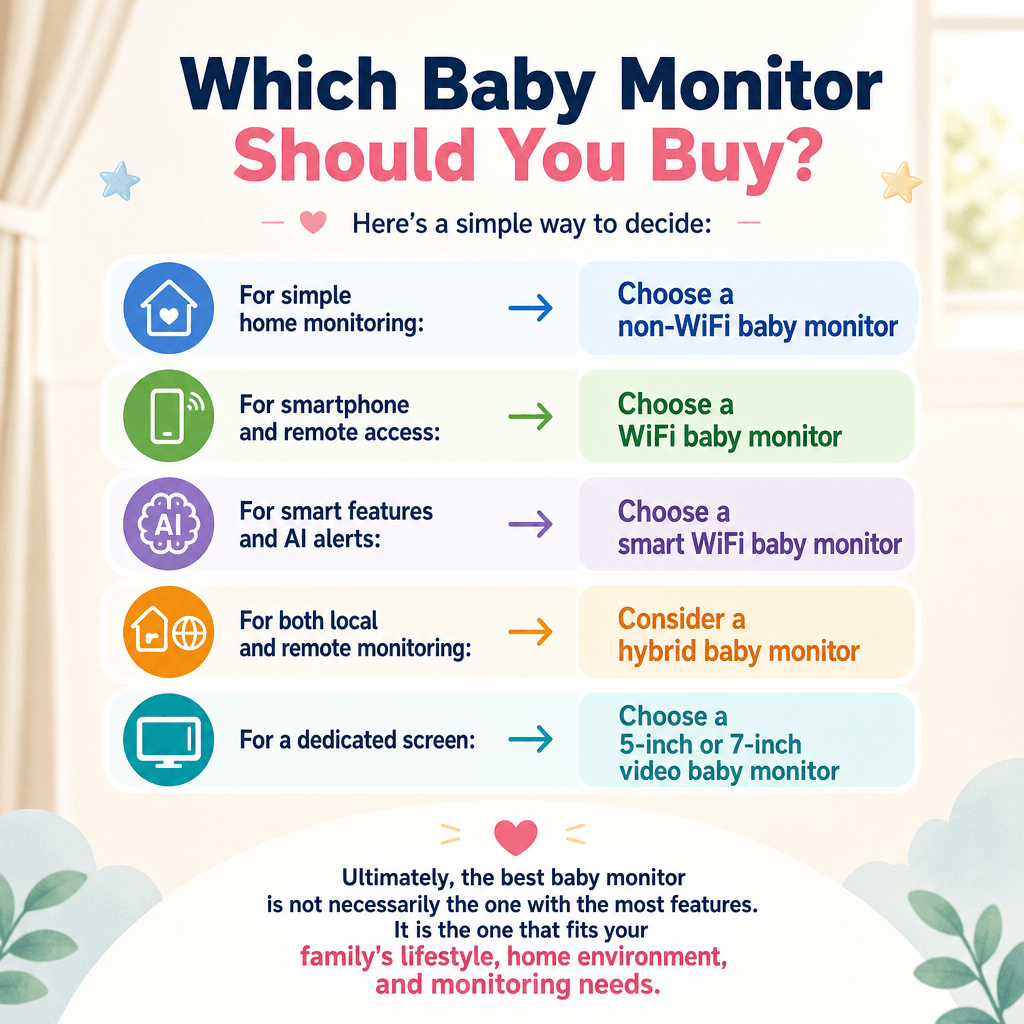
Here a simple way to decide:
For simple home monitoring:
→ Choose a non-WiFi baby monitor
For smartphone and remote access:
→ Choose a WiFi baby monitor
For smart features and AI alerts:
→ Choose a smart WiFi baby monitor
For both local and remote monitoring:
→ Consider a hybrid baby monitor
For a dedicated screen:
→ Choose a 5-inch or 7-inch video baby monitor
Ultimately, the best baby monitor is not necessarily the one with the most features. It is the one that fits your family lifestyle, home environment, and monitoring needs.
Final Thoughts
The choice between a WiFi and non-WiFi baby monitor comes down to convenience, connectivity, privacy, and features.
WiFi baby monitors are ideal for parents who want remote access, smartphone control, and smart monitoring features.
Non-WiFi baby monitors are a great choice for parents who prefer simple setup, dedicated screens, and monitoring without an internet connection.
If you want the best of both worlds, a hybrid baby monitor can provide additional flexibility.
Before making your decision, consider how you will use the monitor every day. Think about whether you need remote access, how important smart features are to you, and whether you prefer a dedicated parent display.
The right baby monitor should give parents greater convenience and peace of mind while keeping everyday monitoring simple.