
When your baby is sleeping, it is natural to wonder whether everything is okay. Is your baby breathing normally? Are they sleeping comfortably? Should you check the crib again?
A baby breathing monitor can provide parents with another layer of information during sleep by detecting breathing-related movement and, depending on the technology, providing alerts or sleep insights.
But how exactly does a baby breathing monitor work? What is the difference between a traditional baby monitor and a breathing monitor? And can a contactless baby breathing monitor really monitor your baby breathing without a wearable sensor?
In this guide, we’ll explain how baby breathing monitors work, the main technologies available, what they can and cannot tell you, and what to look for when choosing one for your family.
Important: A consumer baby monitor is designed to support everyday monitoring and should not replace adult supervision, safe sleep practices, or professional medical advice. If your baby has a medical condition or has been prescribed medical monitoring, always follow your healthcare provider recommendations.
A baby breathing monitor is a type of infant monitoring device designed to detect and track breathing-related movement while a baby is sleeping.
Traditional baby monitors mainly allow parents to:
- See their baby through a camera
- Hear sounds and crying
- Monitor movement
- Communicate through two-way audio
- Check room conditions such as temperature
A smart baby breathing monitor can add another layer of information by analyzing subtle movements associated with breathing.
Depending on the technology, the monitor may detect movement of the baby chest or abdomen, movement through the mattress, or extremely small movements using contactless sensing technology.
Some advanced systems may also provide features such as:
- Breathing-related monitoring
- Heart-rate monitoring
- Sleep analysis
- Movement detection
- Crying alerts
- Temperature monitoring
- Smart notifications
- Historical monitoring data
The exact capabilities vary significantly between products, so parents should always check how a particular monitor works before purchasing one.
How Does a Baby Breathing Monitor Work?
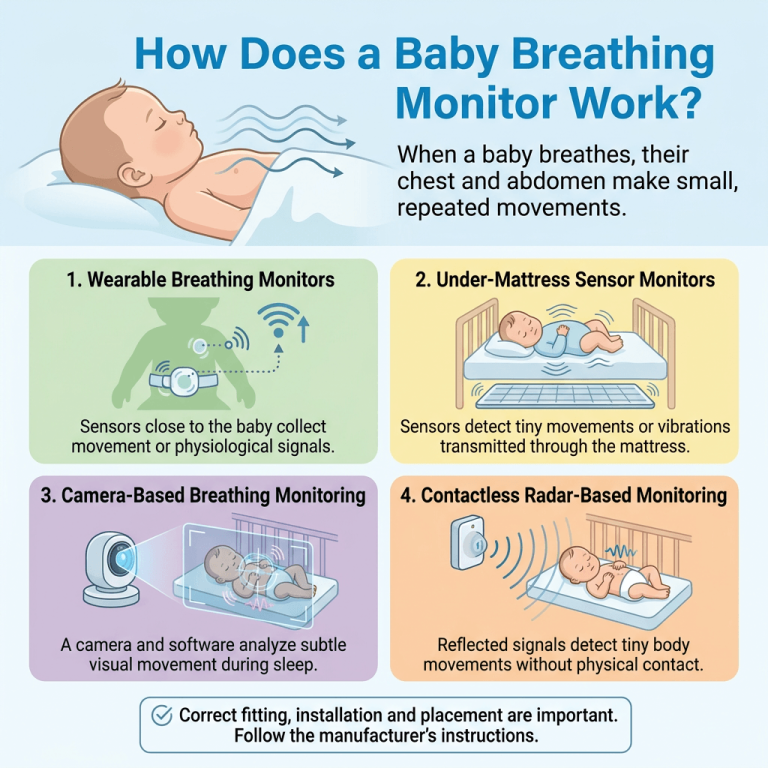
The basic idea is relatively simple.
When a baby breathes, their chest and abdomen make small, repeated movements. A monitoring system attempts to detect these movements and process the resulting signals.
Different baby breathing monitors use different technologies.
1. Wearable Breathing Monitors
Some monitors use a wearable device such as a band, sock, clip, or other accessory.
The wearable contains sensors that collect information related to movement or physiological signals. The data is then transmitted to a monitor or smartphone app.
The main advantage is that the sensor is positioned close to the baby.
However, wearable monitoring also means that parents need to make sure the device is correctly fitted and used according to the manufacturer instructions.
2. Under-Mattress Sensor Monitors
Another approach uses a sensor placed underneath the baby mattress.
Instead of directly attaching a sensor to the baby, the system detects tiny movements or vibrations transmitted through the mattress.
These systems can be useful for parents who prefer not to put a wearable device on their baby.
However, performance can depend on the mattress, crib setup, baby position, and correct installation.
3. Camera-Based Breathing Monitoring
Some smart baby monitors use a camera and software algorithms to analyze visual movement.
For example, the system may look for subtle changes in the baby chest or body position during sleep.
This approach can combine breathing-related monitoring with video monitoring, allowing parents to see their baby and receive monitoring information through the same system.
The camera needs an appropriate view of the baby, so placement is particularly important.
4. Contactless Radar-Based Monitoring
A newer approach uses radar-style sensing technology to detect extremely small movements without physically touching the baby.
The principle is based on detecting changes in reflected signals caused by tiny movements of the body.
Because breathing produces repeated movement in the chest and abdomen, the system can process these patterns to provide breathing-related information.
This is one of the most interesting developments in smart baby monitoring because it can potentially provide monitoring without requiring the baby to wear a sensor or special clothing.
What Does "Contactless" Baby Breathing Monitoring Mean?
The term contactless baby breathing monitor means that the monitoring technology does not need to physically attach a sensor to the baby body.
Instead, the sensing system is positioned near the baby sleep area.
This can be appealing to parents because there is:
- No wearable device to remember
- No sensor directly against the baby skin
- No need to recharge a wearable sensor
- Less equipment physically attached to the baby
- A simpler monitoring setup
Contactless monitoring can also be integrated into a larger smart baby monitor system that combines video, sleep analysis, alerts, and other monitoring functions.
However, “contactless” does not mean “perfectly accurate in every situation.” Movement, positioning, distance, obstructions, and the surrounding environment can affect monitoring performance.
Parents should always follow the manufacturer installation and usage instructions.
Can a Baby Monitor Really Detect Breathing?
A baby monitor does not literally see air moving in and out of the lungs.
Instead, monitoring technologies generally detect physical signals associated with breathing.
For example, breathing can cause subtle and repetitive movement in the chest or abdomen. A sensor or camera can detect these movements, and software can analyze the pattern.
Radar-based systems work differently from cameras. Rather than relying entirely on visible images, radar sensing can detect small changes in distance or movement.
This is why the term “breathing monitoring” should be understood in the context of the specific technology used by the product.
Parents should also distinguish between a consumer smart baby monitor and a medical monitoring device. A consumer product should not be treated as a diagnostic tool.
What Can a Smart Baby Monitor Track?
Modern smart baby monitors are becoming much more than simple video cameras.
Depending on the model, a smart baby monitor may provide several types of information.
Breathing-Related Information
The monitor can detect patterns of movement associated with breathing and display relevant information to parents.
Heart Rate
Some advanced monitoring systems are designed to provide heart-rate information using contactless or sensor-based technology.
This can give parents additional information during sleep.
Sleep Activity
Sleep analysis can help parents understand patterns such as:
- When the baby falls asleep
- When the baby wakes up
- Movement during sleep
- Sleep duration
- Sleep interruptions
Sleep information can be particularly useful for parents trying to understand their baby daily sleep routine.
Crying Detection
Some smart baby monitors use algorithms to identify crying and send an alert to the parent.
This can be especially useful when parents are in another room or temporarily away from the nursery.
Movement and Smart Alerts
Advanced systems can also detect certain movement events or predefined areas.
For example, smart alerts may notify parents when movement is detected or when a baby moves outside a defined monitoring area.
Contactless vs Wearable Baby Breathing Monitors
Which type is better?
There is no single answer for every family. It depends on what you value most.
| Feature | Contactless Monitor | Wearable Monitor |
|---|---|---|
| Sensor attached to baby | No | Usually yes |
| Contact with baby skin | No | May be required |
| Setup | Generally simple | Requires correct fitting |
| Video monitoring | Often available | Depends on product |
| Breathing-related monitoring | Yes, depending on technology | Yes, depending on technology |
| Sleep analysis | Available on some models | Available on some models |
| Convenience | High | Depends on wearable |
| Best for | Parents seeking contact-free monitoring | Parents comfortable with wearable devices |
A contactless system can be particularly attractive to parents who want monitoring information without adding another device to the baby clothing or body.
Are Baby Breathing Monitors Safe?

Safety is one of the most important questions parents have.
The first thing to understand is that a baby breathing monitor is not a replacement for safe sleep practices or adult supervision.
Parents should continue to follow established safe sleep recommendations, including placing babies in an appropriate sleep environment.
A monitoring device should be considered an additional tool rather than a guarantee that something will never go wrong.
Parents should also understand the possibility of inaccurate readings or missed events. Any monitoring technology can be affected by factors such as:
- Baby movement
- Baby position
- Incorrect installation
- Obstructions
- Poor camera angle
- Environmental interference
- Device limitations
For this reason, parents should carefully follow the manufacturer instructions and understand what the product is designed to monitor.
If your baby has a medical condition or requires clinical monitoring, a consumer baby monitor should not replace the monitoring recommended by your healthcare professional.
Does a Baby Breathing Monitor Prevent SIDS?
No consumer baby monitor should be presented as a guaranteed way to prevent SIDS.
This distinction is extremely important.
Parents may purchase a breathing monitor because they want reassurance while their baby sleeps. However, monitoring technology should not create a false sense of security.
Safe sleep practices remain essential.
A baby monitor can help parents observe their baby and understand sleep-related patterns, but it should not be marketed or relied upon as a device that prevents SIDS or replaces medical care.
What Should You Look for in a Baby Breathing Monitor?
If you’re considering a smart baby monitor, look beyond the word “smart.”
Here are some features worth comparing.
1. Contactless Breathing Monitoring
If you prefer not to use a wearable sensor, look for technology that can monitor breathing-related movement without physically attaching a device to your baby.
2. Heart-Rate Monitoring
Some advanced baby monitors can provide heart-rate information.
If this feature is important to you, check how the manufacturer obtains the data and clearly understand its intended use.
3. Sleep Analysis
Sleep tracking can provide a broader picture than simply watching a live video feed.
Look for systems that can help you understand sleep duration, movement, wake periods, and other sleep-related patterns.
4. Clear Video
Breathing-related monitoring is only one part of a smart baby monitor.
A high-quality camera is still important for everyday monitoring.
Consider:
- Resolution
- Viewing angle
- Night vision
- Digital zoom
- Pan and tilt
- Screen size
5. Smart Alerts
A useful smart monitor should provide alerts that are meaningful rather than overwhelming.
Depending on the model, alerts may include:
- Crying
- Movement
- Temperature changes
- Breathing-related events
- Activity in a defined area
6. Connection Type
Baby monitors use different connection technologies.
Some smart baby monitors depend heavily on WiFi and smartphone apps, while others use a local wireless connection between the camera and a dedicated parent unit. If you’re comparing the two connection types, our guide to WiFi vs. Non-WiFi Baby Monitors can help you understand which option may be better for your family.
Consider whether you want:
- Remote smartphone viewing
- A dedicated parent monitor
- Local connectivity
- Internet-free operation
- A combination of these options
7. Privacy
Because a baby monitor may collect video and other monitoring data, privacy should also be considered.
Parents should understand:
- Where data is stored
- Whether an app is required
- Whether cloud storage is used
- How accounts are protected
- Who can access the monitoring data
Smart Radar Baby Monitor: A Contactless Approach to Baby Monitoring
As baby monitor technology develops, parents are looking for more than basic video.
A modern smart baby monitor can combine video monitoring with sleep insights, smart alerts, and contactless monitoring technologies.
Our Smart Radar Baby Monitor is designed around this idea.
The 7-inch smart baby monitor combines a large HD touchscreen with advanced monitoring features to give parents a more comprehensive view of their baby sleep environment.
Contactless Breathing and Heart-Rate Monitoring
The Smart Radar Baby Monitor is designed to provide contactless breathing and heart-rate monitoring without requiring a wearable sensor on the baby.
This makes it possible to monitor important sleep-related information while keeping the baby sleep setup simple.
Sleep Analysis
Instead of only showing a live video feed, the system can provide sleep-related information to help parents better understand their baby sleeping patterns.
Real-Time and Historical Data
Parents can view real-time monitoring information and access historical data, making it easier to understand changes and patterns over time.
AI Smart Alerts
The monitor also combines AI-powered features designed for everyday baby monitoring, including:
- AI crying alerts
- AI virtual fence
- Movement-related alerts
- Sleep-related monitoring
- Temperature alerts
These features are designed to help parents stay informed without having to constantly watch the screen.
7-Inch HD Touchscreen
The large 7-inch full-color touchscreen provides a convenient way to view your baby without relying entirely on a smartphone.
The touchscreen interface also makes it easier to access monitoring information directly from the parent unit.
Multi-Camera Support
For families who want to monitor more than one child or room, the system can support multiple cameras and different viewing modes.
This can be useful as your family or monitoring needs change.
Who Might Consider a Contactless Baby Monitor?
A contactless baby breathing monitor may be worth considering if you:
- Frequently check your baby while they sleep
- Want additional sleep-related information
- Prefer not to use wearable sensors
- Want breathing-related monitoring alongside video
- Want smart alerts instead of constantly watching a screen
- Want a larger dedicated parent display
- Are interested in AI-powered baby monitoring technology
However, not every family needs the same features.
If you only need basic video and audio monitoring, a traditional baby monitor may be enough.
If you want sleep insights, contactless monitoring, smart alerts, and additional monitoring information, a smart baby monitor may provide more value.
Baby Breathing Monitor FAQs
How does a baby breathing monitor work?
A baby breathing monitor detects physical signals associated with breathing, such as subtle chest or body movement. Depending on the product, this may be done using wearable sensors, under-mattress sensors, cameras, or contactless radar-style technology.
Can a baby monitor detect breathing without touching the baby?
Yes. Some contactless baby monitors use camera-based or radar-based sensing technologies to detect movement associated with breathing without attaching a sensor to the baby.
What is the difference between a baby monitor and a breathing monitor?
A traditional baby monitor mainly provides video and audio. A breathing monitor adds technology designed to detect breathing-related movement or other physiological information, depending on the product.
Can a baby monitor track heart rate?
Some advanced baby monitoring systems are designed to provide heart-rate information. However, parents should carefully review the manufacturer technology, intended use, limitations, and regulatory status before relying on such information.
Is a baby breathing monitor a medical device?
Not necessarily. Many consumer baby monitors are designed for everyday monitoring rather than medical diagnosis or treatment. Parents should check the specific product intended use and regulatory information.
Do I need a baby breathing monitor?
Not every family needs one. A traditional baby monitor may be sufficient if you primarily want video and audio. A smart breathing monitor may be useful if you want additional sleep-related information and contactless monitoring features.
Final Thoughts
A baby breathing monitor can give parents more information than a traditional video monitor by detecting subtle movements associated with breathing and, depending on the technology, providing sleep insights, heart-rate information, and smart alerts.
The technology behind these products varies widely. Wearable sensors, under-mattress sensors, camera-based systems, and contactless radar technologies all take different approaches to baby monitoring.
For parents who prefer a simpler setup without attaching a sensor to their baby, a contactless baby breathing monitor can be an interesting option.
At the same time, monitoring technology should always be viewed as an additional parenting tool—not a replacement for safe sleep practices, adult supervision, or professional medical care.
If you’re looking for a smarter way to understand your baby sleep, explore the features of our Smart Radar Baby Monitor, including contactless breathing and heart-rate monitoring, sleep analysis, AI alerts, and a large 7-inch touchscreen designed for everyday baby care.