
A traditional baby monitor lets parents see and hear their baby from another room. But as baby monitoring technology has evolved, modern devices can do much more than stream video and audio.
A smart baby monitor combines a camera with technologies such as artificial intelligence, motion detection, sleep analysis, smart alerts, and, on some models, breathing or heart-rate monitoring.
Instead of simply asking, “Can I see my baby?”, a smart baby monitor can help parents answer additional questions:
Is my baby sleeping or awake?
Did my baby start crying?
Is there movement in the crib?
Is the room too warm or too cold?
What does my baby sleep pattern look like?
Can I receive an alert when something needs my attention?
But how does a smart baby monitor actually work, and which features are genuinely useful?
This guide explains how smart baby monitors work, how they differ from traditional models, what technologies they use, and what parents should consider when choosing one.
Important: A consumer smart baby monitor is designed to support everyday monitoring. It should not replace adult supervision, safe sleep practices, or professional medical care.
What Is a Smart Baby Monitor?
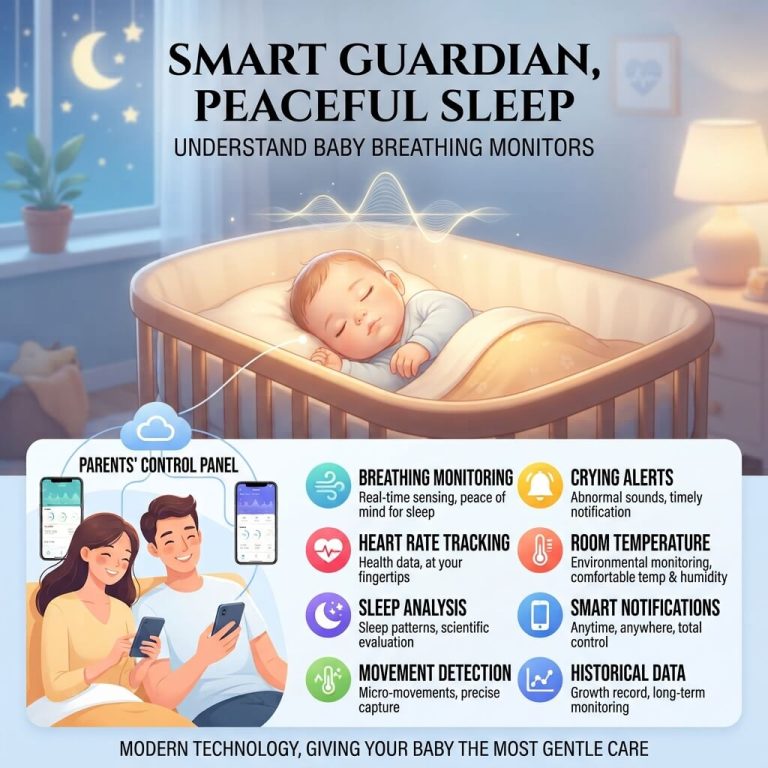
A smart baby monitor is an advanced baby monitoring system that combines video and audio monitoring with additional technologies designed to provide more information and automated alerts.
A traditional baby monitor generally focuses on two functions:
1.Seeing your baby
2.Hearing your baby
A smart baby monitor can add features such as:
- AI-powered detection
- Crying detection
- Movement detection
- Sleep tracking
- Sleep analysis
- Breathing-related monitoring
- Heart-rate monitoring
- Temperature monitoring
- Smart alerts
- Two-way communication
- Remote viewing
- Multi-camera monitoring
- Historical data
The exact features depend on the product.
The important difference is that a smart monitor does not simply transmit information. It can also process and interpret certain types of information to help parents understand what is happening.
How Does a Smart Baby Monitor Work?
A smart baby monitor usually combines several components that work together.
1. Camera and Image Sensor
The camera captures video of the baby sleep area.
Depending on the model, the camera may offer:
- HD or Full HD video
- Wide-angle viewing
- Pan and tilt
- Digital zoom
- Infrared night vision
- Color night vision
- Multiple viewing modes
The camera provides the visual information that parents need for everyday monitoring.
2. Processor and Software
This is where a smart monitor becomes different from a basic camera.
The monitor processor and software can analyze information captured by the camera or other sensors.
For example, software may be used to identify:
- Crying
- Movement
- Baby activity
- Changes in sleep behavior
- Objects or people within a defined area
- Specific monitoring events
More advanced systems may use AI algorithms to analyze patterns and generate alerts.
3. Sensors
Some smart baby monitors use additional sensors to collect information beyond video.
Depending on the product, these may include sensors for:
- Temperature
- Humidity
- Movement
- Breathing-related signals
- Heart rate
- Environmental conditions
This allows the monitor to provide a broader picture of the baby sleep environment.
4. Display or Smartphone App
The information can then be presented through a dedicated parent unit, smartphone app, or both.
A dedicated monitor allows parents to quickly check their baby without unlocking a phone.
An app-based system may offer additional capabilities such as:
- Remote viewing
- Notifications
- Historical data
- Multiple users
- Cloud storage
- Settings management
Different families may prefer different approaches.
Smart Baby Monitor vs Traditional Baby Monitor
One of the easiest ways to understand a smart baby monitor is to compare it with a traditional model.
| Feature | Traditional Baby Monitor | Smart Baby Monitor |
|---|---|---|
| Live video | Yes | Yes |
| Audio monitoring | Yes | Yes |
| Night vision | Common | Common |
| Two-way audio | Often | Usually |
| Movement detection | Some models | Common |
| Cry detection | Limited | Common |
| Sleep analysis | Rare | Available on some models |
| AI detection | Rare | Available |
| Breathing monitoring | Rare | Available on some models |
| Heart-rate monitoring | Rare | Available on some models |
| Smart alerts | Limited | Common |
| Historical data | Limited | Available on some models |
| Smartphone integration | Depends on model | Common |
| Multi-camera support | Some models | Common on advanced models |
The key difference is not simply the number of features.
A smart baby monitor is designed to turn monitoring data into useful information or alerts, rather than requiring parents to constantly watch the screen themselves.
What Smart Features Can a Baby Monitor Offer?
Smart baby monitors can include many different technologies.
Here are some of the most common.
AI Crying Detection
One of the most practical smart features is crying detection.
Instead of continuously watching the monitor, parents can receive an alert when the system detects crying or sounds associated with a baby needing attention.
This can be particularly useful when:
- You’re cooking
- You’re working
- You’re in another room
- You’re doing household chores
- The monitor is outside your direct line of sight
AI-based sound detection can help reduce the need to constantly check the screen.
Movement Detection
Smart baby monitors can also detect movement in the monitoring area.
Depending on the product, movement detection can help parents know when their baby is becoming active or changing position.
Some systems can also define a virtual monitoring area and send an alert when movement occurs outside that area.
AI Virtual Fence
An AI virtual fence allows parents to define a specific area that should be monitored.
For example, parents may define the crib or sleeping area as a monitoring zone.
If the system detects activity outside the defined area, it can send an alert.
This type of feature can be particularly useful as babies become more mobile.
Sleep Tracking and Sleep Analysis
Sleep tracking is another major difference between smart and traditional baby monitors.
Instead of only showing a live video feed, a smart monitor may collect information about sleep-related activity.
Depending on the system, parents may be able to see:
- Sleep duration
- Wake periods
- Movement during sleep
- Sleep interruptions
- Sleep patterns over time
This information can help parents better understand their baby routine.
However, sleep tracking should be viewed as informational rather than a medical assessment.
Can a Smart Baby Monitor Monitor Breathing?
Some advanced smart baby monitors are designed to provide breathing-related monitoring.If you’re interested in how this technology works, read our guide: How Do Baby Breathing Monitors Work?
The technology can vary significantly.
Some systems use wearable sensors, while others use camera-based monitoring, under-mattress sensors, or contactless sensing technologies.
A contactless system may detect subtle movements associated with breathing without requiring a sensor to be attached directly to the baby.
For example, a radar-based system can detect extremely small changes in movement and process those signals to provide breathing-related information.
This is one reason why smart baby monitors are becoming more sophisticated than traditional video monitors.
If you’re interested in this topic specifically, see our detailed guide:
How Do Baby Breathing Monitors Work? A Complete Guide for Parents
Can a Smart Baby Monitor Track Heart Rate?
Some advanced baby monitors are designed to provide heart-rate information.
The way this information is collected depends on the technology used by the product.
For parents, the important point is to understand that consumer monitoring technology and clinical medical monitoring are not necessarily the same thing.
A smart baby monitor can provide additional information that may help parents observe their baby during sleep, but it should not automatically be interpreted as a medical diagnosis.
If your baby requires clinical monitoring, follow the recommendations of your healthcare provider.
How Does AI Work in a Smart Baby Monitor?
Artificial intelligence is becoming an increasingly important part of baby monitoring.
At a basic level, AI can analyze patterns in video, sound, or sensor data.
For example, a smart system may analyze:
Video → movement → activity → alert
or:
Audio → sound pattern → crying detection → notification
More advanced systems can combine multiple types of information.
For example:
Camera + sensors + software → monitoring data → analysis → smart alert
This can make the monitoring experience more proactive.
Instead of parents constantly asking:
“Is my baby awake?”
the system can potentially notify them when a relevant event is detected.
What Are Smart Alerts?
Smart alerts are notifications triggered by predefined events or detected patterns.
Depending on the baby monitor, alerts may include:
- Crying alerts
- Movement alerts
- Temperature alerts
- Activity alerts
- Virtual fence alerts
- Breathing-related alerts
- Other customized notifications
The goal is not to generate as many notifications as possible.
A good smart baby monitor should provide alerts that are useful enough to help parents pay attention when necessary without creating unnecessary notification fatigue.
Do Smart Baby Monitors Need WiFi?
Not necessarily.
This is an important distinction when choosing a baby monitor.
Some smart baby monitors depend heavily on WiFi and smartphone apps, while others use a local wireless connection between the camera and a dedicated parent unit. If you’re comparing the two connection types, our guide to WiFi vs. Non-WiFi Baby Monitors can help you understand which option may be better for your family.
Some systems can combine different connection methods.
WiFi-Based Baby Monitor
A WiFi baby monitor can provide features such as:
- Remote smartphone viewing
- App notifications
- Cloud services
- Remote access
- Historical data
This can be convenient when parents want to monitor their baby while away from home.
However, it also means that connectivity, network security, and internet availability become important considerations.
Local Wireless Baby Monitor
A local connection can allow the camera and parent unit to communicate without relying on an external internet connection.
This may appeal to parents who prioritize:
- Simplicity
- Privacy
- Local monitoring
- A dedicated parent screen
- Reduced dependence on internet connectivity
Neither approach is automatically better for every family.
The right choice depends on how you plan to use the monitor.
Are Smart Baby Monitors Safe?

Safety should always be considered when purchasing any baby monitoring device.
First, parents should understand that a smart baby monitor is an additional monitoring tool, not a replacement for safe sleep practices or adult supervision.
Second, parents should follow the manufacturer installation instructions carefully.
Camera placement, sensing distance, connection setup, and the surrounding environment can affect monitoring performance.
Third, parents should understand the limitations of smart monitoring.
No consumer monitoring system can guarantee that every event will be detected correctly.
Parents should also pay attention to privacy and cybersecurity, particularly when using a WiFi-connected monitor or smartphone app.
Before purchasing a product, consider:
- Does it require an internet connection?
- Is cloud storage used?
- How is data protected?
- Who can access the account?
- Can the system operate locally?
- Does it require a smartphone?
- Is there a dedicated parent monitor?
What Should You Look for in a Smart Baby Monitor?
With so many features available, it can be difficult to know what actually matters.
Here are some of the most important factors to consider.
1. Video Quality
Look for a resolution that provides a clear view of your baby face and sleeping area.
HD video can make it easier to see movement, position, and activity.
2. Night Vision
Since babies sleep at night, good night vision is essential.
Infrared night vision can provide visibility in low-light environments without requiring parents to turn on bright lights.
3. Viewing Angle
A wider viewing angle can reduce blind spots.
Pan-and-tilt functionality can also make it easier to adjust the monitoring area.
4. Smart Alerts
Consider which alerts are actually useful for your family.
Crying, movement, temperature, and activity alerts can help reduce the need for constant screen monitoring.
5. Sleep Analysis
If you want more than live video, sleep tracking and sleep analysis can provide additional information about your baby routine.
6. Breathing or Heart-Rate Monitoring
If these features are important to you, look carefully at how they work.
Don’t simply compare product names.
Check whether the system uses:
- Wearable sensors
- Camera-based monitoring
- Under-mattress sensors
- Radar or contactless sensing
Also check the intended use and limitations of the technology.
7. Parent Unit vs. Smartphone
Ask yourself how you actually want to monitor your baby.
A dedicated parent unit can be convenient during everyday household activities.
A smartphone app can be useful when you’re away from home.
Some parents may prefer having both.
8. Privacy and Connectivity
Think about how much connectivity you actually need.
If remote access is important, a WiFi model may make sense.
If local monitoring and privacy are higher priorities, a dedicated local connection may be more attractive.
Smart Radar Baby Monitor: Combining Monitoring and Smart Technology
The development of smart baby monitoring is moving beyond simple video and audio.
Our Smart Radar Baby Monitor combines a large 7-inch touchscreen with advanced monitoring technologies designed for modern parents.
Instead of relying only on a traditional camera feed, it brings several smart monitoring functions together.
Contactless Breathing and Heart-Rate Monitoring
The Smart Radar Baby Monitor is designed to provide contactless breathing and heart-rate monitoring.
Parents can monitor this information without requiring a wearable sensor to be attached directly to the baby.
This contactless approach can make everyday monitoring simpler while keeping the baby sleep setup free from additional wearable devices.
Sleep Analysis
The monitor also supports sleep analysis, helping parents gain additional insight into their baby sleep activity rather than relying only on a live video feed.
Real-Time and Historical Monitoring Data
Parents can view real-time monitoring information and access historical data to better understand patterns over time.
This provides a broader view of the baby sleep and monitoring activity.
AI Crying Alarm
The AI crying alarm is designed to identify crying and provide an alert to parents.
This means you don’t have to continuously watch the monitor to know when your baby may need attention.
AI Virtual Fence
The AI virtual fence allows parents to define a specific monitoring area.
When the system detects relevant activity around the defined area, it can provide an alert.
Temperature Alerts
Monitoring the nursery environment is another useful part of smart baby care.
The system can provide temperature-related information and alerts, helping parents stay aware of changes in the baby surroundings.
7-Inch HD Touchscreen
The 7-inch full-color touchscreen provides a large and convenient display for everyday monitoring.
Parents can check their baby directly from the dedicated monitor without relying entirely on a smartphone.
Multi-Camera Support
The system can also support multiple cameras, allowing parents to monitor different rooms or children from one parent unit.
This can become particularly useful as the family monitoring needs grow.
Who Needs a Smart Baby Monitor?
Not every parent needs every smart feature.
A basic baby monitor may be perfectly suitable if you only want:
- Video
- Audio
- Night vision
- Two-way communication
A smart baby monitor may be more appropriate if you want additional capabilities such as:
- AI detection
- Smart alerts
- Sleep analysis
- Contactless monitoring
- Breathing-related monitoring
- Heart-rate monitoring
- Temperature information
- Historical data
- Multi-camera support
The best baby monitor is ultimately the one that fits your family needs, budget, home environment, and preferred monitoring method.
Frequently Asked Questions
What is a smart baby monitor?
A smart baby monitor is an advanced infant monitoring system that combines video and audio with technologies such as AI detection, smart alerts, sleep analysis, movement monitoring, and, on some models, breathing or heart-rate monitoring.
How does a smart baby monitor work?
A smart baby monitor uses cameras, sensors, processors, and software to collect and analyze information about the baby environment and activity. Depending on the model, it can detect events such as crying, movement, temperature changes, or other monitoring signals and send alerts to parents.
What is the difference between a smart baby monitor and a regular baby monitor?
A regular baby monitor primarily provides video and audio. A smart baby monitor adds automated analysis and features such as AI detection, sleep tracking, smart alerts, and potentially breathing or heart-rate monitoring.
Can a smart baby monitor monitor breathing without a wearable?
Some smart baby monitors use contactless technologies such as camera-based or radar-based sensing to detect movement associated with breathing without attaching a wearable sensor to the baby.
Does a smart baby monitor need WiFi?
Not always. Some smart baby monitors use WiFi and smartphone apps, while others use local wireless connections and dedicated parent units. Some products support different connection options.
Can a smart baby monitor track sleep?
Some smart baby monitors provide sleep tracking or sleep analysis based on detected movement and activity. The exact information available depends on the product.
Are smart baby monitors worth it?
For parents who only need basic video and audio, a traditional baby monitor may be enough. Smart baby monitors can provide additional value for parents who want features such as AI alerts, sleep analysis, contactless monitoring, or other smart monitoring functions.
Can a smart baby monitor replace parental supervision?
No. A baby monitor should be used as an additional monitoring tool and should not replace adult supervision, safe sleep practices, or professional medical care.
Final Thoughts
A smart baby monitor is essentially the next step beyond traditional video monitoring.
Instead of simply showing parents what is happening in the nursery, smart monitoring technology can analyze selected information and provide useful alerts, sleep insights, and additional monitoring data.
Depending on the model, this may include AI crying detection, movement detection, sleep analysis, temperature monitoring, breathing-related monitoring, heart-rate monitoring, and other smart features.
For parents who want a more comprehensive approach to everyday baby monitoring, a contactless smart baby monitor can provide an interesting combination of convenience and technology.
The key is to choose features based on your family actual needs rather than simply choosing the monitor with the longest feature list.
If you’re looking for a smart way to monitor your baby sleep and everyday activity, explore our Smart Radar Baby Monitor with contactless breathing and heart-rate monitoring, sleep analysis, AI alerts, a 7-inch HD touchscreen, and multi-camera support.
Once you’ve decided which features you need, you may also want to consider the potential cost and whether your baby monitor may qualify for FSA or HSA reimbursement. See our guide to Are Baby Monitors FSA Eligible? to learn more.